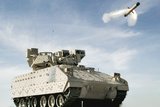
Team Redback officially launches IFV for Australia
Three prototypes will be delivered soon for test and evaluation trials under Project Land 400 Phase 3.


Hanwha Defense Australia and Team Redback on 12 January formally launched the AS21 Redback IFV, as they prepare to deliver three of the vehicles to compete in test and evaluation trials being conducted as part of the Risk Mitigation Activity (RMA) for Project Land 400 Phase 3.
The new IFV is being offered to replace the Australian Army’s fleet of M113AS4 vehicles.
In its standard IFV configuration, Redback will be able to accommodate three crew, eight passengers, an active protection system and a turret equipped with a 30mm cannon and ATGMs. Other variants utilising the same hull, such as a mortar carrier, will also be proposed.
Land 400 Phase 3 is described by Shephard Defence Insight as the largest and most expensive project in the history of the Australian Army, with a predicted cost of up to A$27 billion ($19.5 billion).
The RMA in this programme involves detailed test and evaluation of the vehicles throughout 2021, with the aim of providing objective quality evidence to support a Government decision on the preferred tenderer.
Team Redback is led by Hanwha Defense Australia. Other current members include Electro Optic Systems, Elbit, ECLIPS, Milspec, Bisalloy, Soucy, Marand and CBG Systems.
As part of our promise to deliver comprehensive coverage to our Defence Insight and Premium News subscribers, our curated defence news content provides the latest industry updates, contract awards and programme milestones.
Related Programmes in Defence Insight
Land 400 Phase 3 (Logistics, Ammunition Carrier and Mortar Carrier Variants) [Australia]
Related Equipment in Defence Insight



More from Land Warfare
-
![Euronaval 2026: Faster frigates, evolving contracts and drone motherships lead opening conference]()
Euronaval 2026: Faster frigates, evolving contracts and drone motherships lead opening conference
Fast frigate deliveries to the Hellenic Navy, French pressure on suppliers over open architectures and calls for new classes of warship marked the start of the Paris show.
-
![Canada accelerates uncrewed aerial system procurement for NATO and Arctic forces]()
Canada accelerates uncrewed aerial system procurement for NATO and Arctic forces
Canada plans to acquire at least 120 uncrewed aerial systems through two competitions with combined funding ceilings of C$32 million.
-
![AUSA 2026: companies adapt munitions and missiles for greater effect at lower costs]()
AUSA 2026: companies adapt munitions and missiles for greater effect at lower costs
Rather than developing entirely new weapons, defence companies are looking to build on existing weapons and systems to deliver greater capability, control costs and accelerate fielding.