Need to develop AI-powered red pictures for battlefield situational awareness?
Leverage Systematic’s SitaWare suite to fuse intelligence and share awareness of your opponent’s deployments and capabilities.


Enjoy free access to this sponsored article, all content provided by Systematic
SitaWare has combat-proven capabilities in blue force tracking capabilities, helping militaries around the world plan, co-ordinate, and execute military operations – allowing for superior situational awareness of friendly forces, and what they intend to do. However, knowing where the enemy is on the battlefield, and what kind of unit they are, is just as important to commanders at all levels. The SitaWare suite can deliver this data organically as part of its existing functionality, creating a holistic battlespace view for a military commander.
What is a red picture?
Within the command environment, a red picture is a combined image showing the location and type of enemy forces on the battlefield. This is compiled through a variety of methods – battlefield intelligence, sensor feeds, open-source intelligence data, and more. The SitaWare suite is able to generate a red picture through the use of view selection and layer exports – no extra software or support necessary.
The location of enemy forces can be added into the SitaWare suite through a variety of automated data ingestion via sensor feeds, manual addition by troops reporting positions on the ground, analysts examining video and sensor feeds, or using track management systems such as ADS-B and AIS. Employing NATO standard symbology, meaning is added to the red picture, showing where an opponent is deploying their units, their movements, and capabilities.
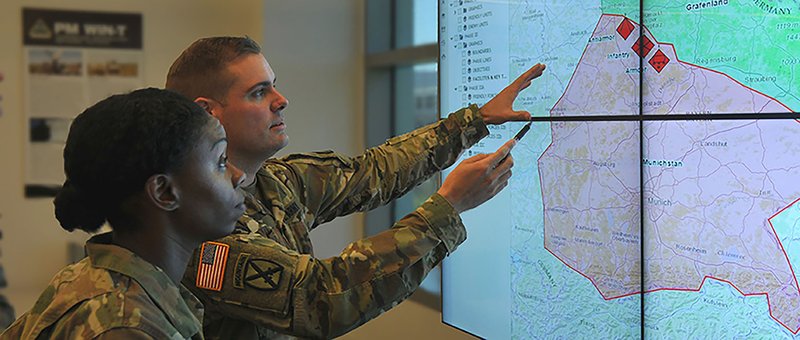
With the continuous synchronisation of data allowing near real-time visualisation, the SitaWare suite tracks and monitors both friendly forces as well as the movements of enemy units. Data delivery through the software stack from fixed headquarters to dismounted soldiers means that the Common Intelligence Picture (CIP) is regularly updated with ease.
Bringing together the information from a red picture can allow for the analysis of the organisation and dispersal of units according to doctrine – helping to understand an opponent’s intent. Additionally, enriching an enemy symbol with data on its parent unit, capabilities, and position can help commanders plan and equip their forces accordingly.
Multiple sources, one single vision
Information management within the command environment has been one of the core benefits of the deployment of SitaWare into militaries undergoing a digitalisation process. Moving away from paper maps and into digital displays means greater data fidelity can be delivered to users across the battlespace. Creating map layers provides specific audiences with the data that is most relevant to them. Multiple ways of communicating – from chat windows to file transfers – mean that requests for support or the distribution of plans and orders are automated, streamlined and made more efficient.
Creating and visualising the red picture comes as part of a fusion capability – formed out of the software’s layer generation and synchronisation capabilities – that has been at the core of SitaWare’s situational awareness principles since it was first deployed.
“Knowing where your own forces are is one thing – knowing the enemy’s location, identity, and capability is another. Being able to distribute this knowledge around the battlespace easily through a red picture layer allows commanders to be fully aware of everything around them, and the capabilities they may be operating against. This allows them the opportunity to plan ahead and target weaknesses by maximising their strengths”— Brigadier General (ret’d) Henrik Sommer, Director, Multidomain C2 and Intelligence, Systematic
Ingestion of a variety of data source formats, including ADS-B, APP-11, OTH-GOLD, and MISB, means that detection, tracking, and reporting objects within an area of operations is assured. Additional information feeds – such as equipment libraries and capability data – help to enrich the intelligence picture for users in the battlespace. Users can add further data on enemy forces, such as video clips and snapshots, field photographs, and electronic intercept data, to add further depth to a red picture and support commanders’ decision-making capabilities.
Entity processing with correlation and fusion
Once you know where the enemy is, tracking them is the next step, with the generation of red-force tracks helping to understand an opponent’s intent and operational art. Is the movement of an EW unit a screening effort for a larger force, or a feint? How is their disposition reflective of doctrine, and how will this impact their next move?
For land users at the battalion level and above, SitaWare Headquarters utilises an AI-powered correlation and fusion engine to de-duplicate objects detected and reported to ensure the correct CIP is communicated through the battlespace.
SitaWare Maritime users can perform this correlation and fusion work at the ship level, before it is transmitted upwards to a task group or maritime command centre/maritime operations centre (MCC/MOC). Inputs from multiple assets and additional sensors in the area of operations are then correlated into a national recognised maritime picture (RMP), for continued monitoring at the national level or for communication to a multinational coalition command. An RMP and red picture that is filtered according to an area of interest can also be distributed downwards to deployed vessels, ensuring that data is limited to the necessary level for the right users.
To find out more about the SitaWare suite and its intelligence capabilities, be sure to visit Systematic’s stand at IDEX 2025 in Hall 8, B-045. Click here to find out more and book your meeting.

You may also like
More from Industry Spotlights
-
![Patria OPTIME and ILIAS: Orchestrating operational readiness across every domain]()
Patria OPTIME and ILIAS: Orchestrating operational readiness across every domain
Patria OPTIME is a sustainment concept that integrates MRO and lifecycle services into one solution, powered by the ILIAS digital defence platform
-
![“Start planning much earlier”: delivering defence support in an era of disruption]()
“Start planning much earlier”: delivering defence support in an era of disruption
In Conversation… The geopolitical landscape is increasingly uncertain, with the UK and its allies confronting the most unpredictable international environment for decades. To adapt, defence readiness must begin long before assets reach the front line, forging a resilient support enterprise that can thrive in a time of ongoing disruption, argue the partners of Team ORION.
-
![Patria NEMO Navy: Unlocking unmatched versatility and protection for modern naval forces]()
Patria NEMO Navy: Unlocking unmatched versatility and protection for modern naval forces
The Patria NEMO Navy mortar system marks a revolutionary advance in maritime defence technology, offering unparalleled benefits to customers who demand performance, adaptability and safety in their naval operations.
-
![“Communicating at mission speed”: why data security is essential for operational success]()
“Communicating at mission speed”: why data security is essential for operational success
In conversation… Everfox’s Chairman and Chief Executive Officer Dave Wajsgras and Managing Director, International, Colin McKinty discuss the critical importance of information security in defence, minimising insider risk and the company’s international growth strategy with Shephard’s Andrew White.
-
![“Engage with the operational problem”: how software innovation can boost UK defence]()
“Engage with the operational problem”: how software innovation can boost UK defence
In Conversation… Shephard’s Andrew White talks to Zafer Şen, CEO and co-founder of OBSS, about the future of command-and-control software in the age of artificial intelligence, and his company’s ambitions in the UK defence market.
-
![“A survivable architecture”: why resilient communications are no longer a luxury]()
“A survivable architecture”: why resilient communications are no longer a luxury
In Conversation… Military communications must adapt to a rapidly evolving battlespace, characterised by decentralised forces and an increasingly contested electromagnetic spectrum. To survive and thrive, it is vital to prioritise resilient systems and networks, Faisal Munir, President – Mission-Critical Communications at L3Harris Technologies, told Shephard’s Gerrard Cowan.