Rubber tracks to enhance Dutch CV90s
Composite rubber tracks form part of broader €500 million upgrade programme


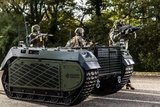
BAE Systems Hägglunds confirmed on 29 October that it is adding a composite rubber track (CRT) system from Soucy to the CV9035NL IFV operated by the Royal Netherlands Army.
A contract, signed earlier in October, also includes development, testing and verification, as well as the delivery of implementation kits for training alongside the customer.
CRTs ‘will improve crew endurance and running costs and significantly reduce weight, which in turn allows for better performance’, BAE Systems Hägglunds claimed. ‘Altogether, the change to rubber tracks increases the potential for further upgrades.’
In addition, the upgrade will cut noise inside the vehicle by 10dB and reduce vibration levels by 65%.
The Royal Netherlands Army is modernising its fleet of 144 CV9035NLs under a €500 million (US$584 million) upgrade programme.
According to Shephard Defence Insight, this includes equipping some of the fleet with the Iron Fist APS from Elbit Systems, making it the first western European country to adopt a hard kill APS. BAE Systems Hägglunds was awarded a contract to carry out the integration work in September 2019.
As part of our promise to deliver comprehensive coverage to our Defence Insight and Premium News subscribers, our curated defence news content provides the latest industry updates, contract awards and programme milestones.
Related Equipment in Defence Insight


More from Land Warfare
-
![Trans-European iMUGS2 uncrewed systems programme set for three-day exercise in 2028]()
Trans-European iMUGS2 uncrewed systems programme set for three-day exercise in 2028
The next stage of the Integrated Modular Unmanned Ground System (iMUGS) programme, dubbed iMUGS2, was launched in November 2025. Three major demonstrations are planned before the end of 2028.
-
![How joint ventures are expanding Rheinmetall's munitions portfolio (video)]()
How joint ventures are expanding Rheinmetall's munitions portfolio (video)
Roman Köhne, CEO of Rheinmetall's Weapon and Ammunition Division, discusses the company's announcements at Eurosatory 2026, including developments in defence technology, precision systems, industrial partnerships and future capability programmes.
-
![Canada reveals first requirements for future long-range air-to-air missile]()
Canada reveals first requirements for future long-range air-to-air missile
Exclusive: Ottawa says its future NORAD interceptor must be highly stealthy, resistant to jamming and capable of engaging threats at very long range, while leaving the competition open to domestic and international suppliers.