Rostec developing correctable artillery projectile
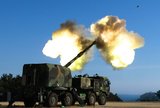
Rostec subsidiary Techmash is developing a new 152mm correctable, high-precision artillery projectile.
The project is currently in the design specification phase. The key feature of the system will be trajectory correction in the final stage of flight, meaning that immediately after firing the ammunition piece will move ballistically like a conventional projectile, but in the vicinity of the target it will use its own control system to correct its trajectory.
Alexander Kochkin, deputy CEO of Techmash, said: ‘It is a new 152mm correctable projectile for artillery of that calibre. It is difficult to build a control system into ammunition of this type due to the high dynamic loads that the projectile undergoes at the moment of firing, while it is spinning within the barrel bore and during the flight.
‘At a spin rate as high as 30,000 revolutions per second, optics do not work — the picture is blurred. We are considering several ways to correct the projectile trajectory in the final stage, including aerodynamic surfaces on the fuse and mini jet engines.’



More from Land Warfare
-
![British Army faces AFV capability gaps despite Boxer and Ajax deliveries]()
British Army faces AFV capability gaps despite Boxer and Ajax deliveries
The British Army continues to face gaps in its armoured fighting vehicle fleet, with replacement plans for Warrior and FV432 still unresolved despite ongoing deliveries of Boxer and Ajax.
-
![US pours another $23 billion into Arsenal of Freedom to ramp up missile production]()
US pours another $23 billion into Arsenal of Freedom to ramp up missile production
The US Department of Defense (DoD) is spending billions of dollars to accelerate missile production to meet demands from the war against Iran and requirements in Ukraine. Manufacture of SM-3 and PAC-3 interceptors is being ramped up, alongside a $22.9 billion commitment to Tomahawk cruise missiles.
-
![Boxer lands another order as contracts and opportunities build momentum]()
Boxer lands another order as contracts and opportunities build momentum
As Germany prepares its €25 billion order under the Arminius framework – the biggest Boxer procurement to date – the platform could become an increasingly powerful contender in European competitions.