Romanian Piranha 5 completes live firing testing


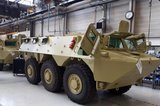
General Dynamics European Land Systems (GDELS) has successfully completed live firing test of the Piranha 5 wheeled armoured vehicle for the Romanian Army, the company announced on 9 April.
The test, which took place at a firing range in Camp Rena, Norway, saw a fully equipped Piranha 5 vehicle perform a series of static and dynamic shooting tests with a 30mm system. The tests qualified the Elbit Systems UT30 MK2 unmanned turret system for the 8x8 wheeled armoured vehicle for the Romanian programme.
GDELS is to deliver up to 227 Piranha 5 wheeled armoured vehicles in six different configurations as part of the Romanian Army’s plan to modernise its legacy wheeled armoured vehicle fleet.
The Piranha 5 vehicles will be produced in Romania under a strategic cooperation and transfer of technology project between GDELS-Mowag and the Romanian company Uzina Mecanică București.
Related Equipment in Defence Insight


More from Land Warfare
-
![AUSA 2026: companies adapt munitions and missiles for greater effect at lower costs]()
AUSA 2026: companies adapt munitions and missiles for greater effect at lower costs
Rather than developing entirely new weapons, defence companies are looking to build on existing weapons and systems to deliver greater capability, control costs and accelerate fielding.
-
![With changing patterns in Middle Eastern procurement, is Europe missing out?]()
With changing patterns in Middle Eastern procurement, is Europe missing out?
Traditional suppliers are struggling to meet the Middle East’s armoured vehicle modernisation needs, creating opportunities for South Korean manufacturers and regional defence industries.
-
![AUSA 2026: CUAS market expands as suppliers target new threats and operational requirements]()
AUSA 2026: CUAS market expands as suppliers target new threats and operational requirements
New developments from MARSS, MyDefence, Mountain Horse Solutions and Rafael suggest that future counter-drone protection will increasingly depend on combining advanced detection, rapid interception and integrated defensive networks.