Rheinmetall launches Lynx 120 for mechanised fire support
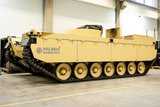
Lynx 120 mechanised fire support vehicle. (Photo: Rheinmetall)
Rheinmetall has armed its Lynx IFV chassis with a 120mm gun for mechanised fire support and antitank operations.


Rheinmetall has launched a new mechanised fire support and antitank variant of the KF41 Lynx IFV.
The Lynx 120 ‘merges a tried-and-tested turret concept’ and a 120mm smoothbore gun (as used on the Leopard 2 MBT) with the Lynx KF 41 chassis, Rheinmetall announced on 18 February. The gun can fire DM11 programmable high-explosive ammunition.
Secondary armament on the Lynx 120 includes a coaxial machine gun, and a .50cal machine gun in the commander’s remote weapon station.
The new vehicle also features an open plug-and-play capability for future upgrades while adhering to NATO standards.
A 360° camera system with automatic target detection and tracking reduces crew workload and boosts situational awareness, Rheinmetall claimed.
Just as with the IFV variant of the Lynx, the new vehicle can be equipped with modular protection modules for a ‘mission-specific response to ballistic threats, improvised explosive devices, explosively formed penetrators and artillery fire’, Rheinmetall stated.
The Lynx 120 would also be the first armoured vehicle to include the Rheinmetall StrikeShield Active Defence System.
Rheinmetall gave no information on potential initial users of the Lynx 120, although it may decide to market the vehicle alongside the KF41 as a complementary platform.

More from Land Warfare
-
![Milrem outlines plans for Havoc and Vector as Ukrainian THeMIS numbers set to double]()
Milrem outlines plans for Havoc and Vector as Ukrainian THeMIS numbers set to double
Milrem’s THeMIS uncrewed ground vehicle is one of the most battle-proven medium UGV platforms in service, with the company looking to have production versions of new large platforms ready before the end of the decade.
-
![US Precision Strike Missile makes combat debut in Operation Epic Fury]()
US Precision Strike Missile makes combat debut in Operation Epic Fury
CENTCOM confirmed that PrSMs have been deployed in the offensive against Iran, bringing what it called “an unrivalled deep strike capability”.
-
![February land forces roundup: ST Engineering and Russia lift the lid on new platforms]()
February land forces roundup: ST Engineering and Russia lift the lid on new platforms
This month we saw a major presence from Turkish, Russian and Chinese companies at the World Defense Show with new vehicles from major suppliers, while elsewhere there were evolving mortar programmes and artillery modernisation efforts.