Rheinmetall Denel wins multimillion-euro charge contract


Rheinmetall Denel Munition has secured an order for several hundred thousand Tactical Modular Charges from an undisclosed international customer.
The artillery charges are due to be delivered in 2021 and are worth more than €70 million ($80 million) according to a 7 April statement from the company.
Tactical Modular Charges are built to propel 155mm artillery shells and can be specially adapted to the customer’s specified weapon systems. The modular design simplifies the handling of the shells in self-propelled howitzer systems.
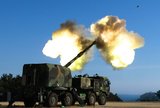
In 2019, Rheinmetall Denel carried out test firing at Alkantpan, South Africa where three new maximum ranges were achieved for a 52-calibre G6 howitzer (pictured) which fired a shell 76km. This is the longest range achieved for a conventional 155mm artillery projectile.
A 39-calibre field howitzer reached 54km and a 52-calibre main gun of a PzH2000 howitzer achieved a new maximum range of 67km.
Related Equipment in Defence Insight

You may also like
More from Land Warfare
-
![US pours another $23 billion into Arsenal of Freedom to ramp up missile production]()
US pours another $23 billion into Arsenal of Freedom to ramp up missile production
The US Department of Defense (DoD) is spending billions of dollars to accelerate missile production to meet demands from the war against Iran and requirements in Ukraine. Manufacture of SM-3 and PAC-3 interceptors is being ramped up, alongside a $22.9 billion commitment to Tomahawk cruise missiles.
-
![Boxer lands another order as contracts and opportunities build momentum]()
Boxer lands another order as contracts and opportunities build momentum
As Germany prepares its €25 billion order under the Arminius framework – the biggest Boxer procurement to date – the platform could become an increasingly powerful contender in European competitions.
-
![Trans-European iMUGS2 uncrewed systems programme set for three-day exercise in 2028]()
Trans-European iMUGS2 uncrewed systems programme set for three-day exercise in 2028
The next stage of the Integrated Modular Unmanned Ground System (iMUGS) programme, dubbed iMUGS2, was launched in November 2025. Three major demonstrations are planned before the end of 2028.
-
![British Army Land Rover replacement plan inches forward]()
British Army Land Rover replacement plan inches forward
The UK Ministry of Defence has proposed a selection date of May 2027 for the Land Rover replacement requirement, with deliveries expected through to 2036. Next month’s DVD exhibition will be a key shop window for bidders.