Raytheon tests compatibility between Excalibur and Caesar
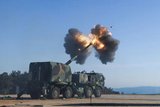
Caesar fires an Excalibur projectile. (Photo: Raytheon Missiles & Defense)
The Caesar-fired Excalibur directly struck two targets at a record-setting range of more than 46km.


Raytheon Missiles & Defense has announced on 18 January that its Excalibur artillery projectiles were fired from a Caesar self-propelled howitzer.
The test proved the compatibility between the two systems and the US Army’s Modular Artillery Charge System (MACS).
The demonstration was conducted in partnership with the US Army and the French company Nexter. According to a Raytheon press release, the Caesar-fired Excalibur directly struck two targets at a distance of more than 46km, marking a new record range for the projectile.
Integration with Caesar adds a level of mobility to Excalibur and shows its compatibility with NATO standards for both conventional and smart ammunition.
Raytheon emphasised that Excalibur is a precision weapon, which can hit at a radial miss distance of less than 2m from the target.
With its GPS-guided capabilities and multiple fuze modes, Excalibur is compatible with the M777, M109, M198, Archer, PzH2000 and SIAC systems.
Related Equipment in Defence Insight


More from Land Warfare
-
![Polaris expands Arctic mobility offering as US military orders grow]()
Polaris expands Arctic mobility offering as US military orders grow
The Military 850 Voyageur 155 Crossover has secured orders from the US Army, Air Force and Marine Corps, addressing demand for agile Arctic mobility with passenger, cargo and towing capacity.
-
![More bidders move onto starting grid for British Army Land Rover replacement programme]()
More bidders move onto starting grid for British Army Land Rover replacement programme
The Light Mobility Vehicle segment of the UK’s Land Mobility Programme for the British Army may actually be about to make progress, or at least likely bidders seem to think so. Shephard spoke with several contenders who revealed their views on how the army should replace the ageing fleet.
-
![Northrop Grumman pushing ahead with smaller Integrated Battle Command System]()
Northrop Grumman pushing ahead with smaller Integrated Battle Command System
Northrop Grumman’s Integrated Battle Command System is in service with Polish forces and is being introduced to US forces, with further development underway on the original platform as well as a smaller, more mobile system.
-
![UK’s ground-based air defence effort remains in assessment phase after third industry day]()
UK’s ground-based air defence effort remains in assessment phase after third industry day
The UK’s plan to introduce a new air defence capability into the British Army will cover short and medium-range defence as well as counter-uncrewed aerial system systems. Timelines are not yet laid out but industry is making plans.