Parker plays crucial role in military projects
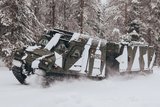
The global leader in motion and control technologies, Parker Hannifin, has helped develop a groundbreaking armoured vehicle that could play a vital role in saving the lives of troops in war torn areas across the world. Designed and developed in the UK, the Ranger will provide at least three times the protection available from other military vehicles currently being used by the MOD, withstanding IEDs (improvised explosive devices), bombs, mines, rocket propelled grenades (RPG 7) and all small arms fire.
Working in collaboration with Universal Engineering, Parker manufactured the revolutionary vehicle’s complete hydraulic system including the engine cooling system fan units, rear ramp actuation mechanism, rear steering assembly, emergency ramp opening and the Auxiliary Power Unit (APU) fans, to provide power if the main engine fails. Remarkably, the 19 tonne Ranger was designed, tested and built in under a year.
The Ranger is different to conventional armoured vehicles as it has no chassis and instead features an armour protected capsule, to which the automotive elements are fitted. This unique design provides an unprecedented level of crew safety with the hull being indirectly connected to the engine, gear box and wheels. Further protection is offered by the armoured belly plates, floating floor and energy absorbing suspended seats, while the vehicle’s hardened cabin has been tested to withstand controlled explosions several times the force of NATO’s standard test for this type of vehicle.
Additionally, the Ranger is fitted with a range of cutting edge military hardware. In particular, it features 6x6 AWD with automatic gearbox, making it easier to drive, while its off-road terrain capability is described as second to none thanks to variable height control, independent suspension and central tyre inflation systems.
By comparison with similar military vehicles currently in operation in Afghanistan the Ranger is faster and more agile, with a top speed of 73mph. Perhaps more importantly, its cabin is bullet-proof and bomb resistant, with the special double-skinned V-shaped hull offering at least three times the protection of existing vehicles.
With troops having to face the daily threat of roadside bombs and mines in places such as Afghanistan, this innovative armoured vehicle has been dubbed a lifesaver. Ranger has been undergoing extensive military testing since its launch and could be ready for full scale production within six months.
Source: Parker Hannifin



More from Land Warfare
-
![Trans-European iMUGS2 uncrewed systems programme set for three-day exercise in 2028]()
Trans-European iMUGS2 uncrewed systems programme set for three-day exercise in 2028
The next stage of the Integrated Modular Unmanned Ground System (iMUGS) programme, dubbed iMUGS2, was launched in November 2025. Three major demonstrations are planned before the end of 2028.
-
![How joint ventures are expanding Rheinmetall's munitions portfolio (video)]()
How joint ventures are expanding Rheinmetall's munitions portfolio (video)
Roman Köhne, CEO of Rheinmetall's Weapon and Ammunition Division, discusses the company's announcements at Eurosatory 2026, including developments in defence technology, precision systems, industrial partnerships and future capability programmes.
-
![Push strengthens for a second JLTV supplier]()
Push strengthens for a second JLTV supplier
A move, launched in May, could lead to a second supplier for the US Marines Corps’ Joint Light Tactical Vehicle requirement. Meanwhile, Wisconsin elected representatives have been pushing for necessary funding to be included in the FY27 budget.