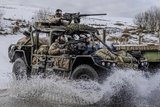
Oshkosh hits significant vehicle delivery milestone


Oshkosh Defense has announced that it has reached a significant milestone for its military vehicle manufacturing line, with the 100,000th vehicle completed on 17 October. The vehicle is part of the first delivery of MRAP All-Terrain Vehicles (M-ATVs) to the United Arab Emirates.
The M-ATV has been a successful programme for the company, with more than 9,500 M-ATVs orders placed worldwide to date. Oshkosh also produces the US Army and US Marine Corps’ heavy and medium vehicles fleets and has developed multiple light vehicle offerings.
John Urias, Oshkosh Corporation executive vice president and president of Oshkosh Defense, said: ‘The founders of Oshkosh Corporation built the company’s first vehicle with patented four-wheel-drive technologies more than 95 years ago, so it is only fitting that the 100,000th defense vehicle is an M-ATV with exceptional off-road mobility. This milestone also speaks to our future. Our vehicles are helping military and security organizations around the world by providing new levels of performance, protection and mobility.’
The company has seen other success over the summer, having received a contract for the Joint Light Tactical Vehicle (JLTV) programme’s Engineering, Manufacturing and Development (EMD) phase. The JLTV aims to replace many of the US military’s aged HMMWVs with a lightweight vehicle that offers greater protection, mobility and transportability.


More from Land Warfare
-
![Europe commits to long-range fires but countries move in different directions]()
Europe commits to long-range fires but countries move in different directions
Sweden, Croatia and France are pursuing different rocket artillery solutions as European armies seek greater reach, survivability and industrial resilience.
-
![Polaris expands Arctic mobility offering as US military orders grow]()
Polaris expands Arctic mobility offering as US military orders grow
The Military 850 Voyageur 155 Crossover has secured orders from the US Army, Air Force and Marine Corps, addressing demand for agile Arctic mobility with passenger, cargo and towing capacity.
-
![More bidders move onto starting grid for British Army Land Rover replacement programme]()
More bidders move onto starting grid for British Army Land Rover replacement programme
The Light Mobility Vehicle segment of the UK’s Land Mobility Programme for the British Army may actually be about to make progress, or at least likely bidders seem to think so. Shephard spoke with several contenders who revealed their views on how the army should replace the ageing fleet.