Oshkosh Defense starts production on ROGUE-Fires and develops MTVR 4×4 variant
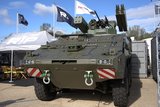
Oshkosh Defense’s ROGUE-Fires is an uncrewed, payload-agnostic vehicle designed to support long-range fires and logistics in expeditionary environments. (Photo: author)
Both ROGUE-Fires and the MTVR demonstrator have been designed for Indo-Pacific mobility and expeditionary operations.


Oshkosh Defense has confirmed that its Remotely Operated Ground Unit for Expeditionary Fires (ROGUE-Fires) is in production, while its Medium Tactical Vehicle Replacement (MTVR) 4×4 Technology Demonstrator with export power capability is in development.
The company displayed both ROGUE-Fires and the MTVR variant at the recent Modern Day Marine (MDM) exposition in Washington, DC.
ROGUE-Fires is an uncrewed, payload-agnostic carrier designed to support the US Marine Corps’ mission to seize and defend maritime terrain. At MDM, Chuck Bunton, associate VP – program management, and Janet Keech, associate VP – aftermarket at Oshkosh, told Shephardthat the platform was designed for
Our news & analysis is now part of Defence Insight®
A Basic-level or higher Defence Insight subscription is now required to view this content.


More from Land Warfare
-
![KNDS points RCH 155 towards longer-range artillery future]()
KNDS points RCH 155 towards longer-range artillery future
KNDS Deutschland has fitted a tracked RCH 155 with a new KNDS France 155mm/58cal ordnance, opening a potential path towards significantly longer-range artillery and a future beyond the current NATO standard.
-
![Air defence offerings multiply in anticipation of emerging requirements]()
Air defence offerings multiply in anticipation of emerging requirements
Air defence and counter-drone weapons continue to be developed, tested and demonstrated in anticipation of growing demand, with most solutions designed to be platform-agnostic and readily integrated onto suitable platforms.
-
![BAE Systems looks beyond the M113 replacement as it tests 30mm AMPV]()
BAE Systems looks beyond the M113 replacement as it tests 30mm AMPV
The development demonstrates how the platform could provide additional firepower and growth potential while the US Army progresses its long-term replacement for the Bradley.