Oshkosh Defense receives $201 million order for FMTV A2 vehicles
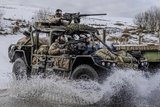
Oshkosh has received orders for more than 37,000 FMTVs. (Photo: Oshkosh Defense)
Oshkosh Defense has been awarded a $201 million contract for additional Family of Medium Tactical Vehicles A2 (FMTV A2) from the US Army, taking the total number of ordered platforms to 2,000.


The order came from US Army Contracting Command, Detroit Arsenal. While the number of vehicles involved was not disclosed, in January this year, Oshkosh received a $141 million order for 414 FMTV A2 plus 56 FMTV trailers.
This means the number of vehicles is likely to be more than 600 but this would depend on outfit.
The FMTV A2 is a modernised version of the A1P2 model, offering higher protection levels, a larger payload, improved off-road mobility, a more powerful engine and upgraded electrics system.
Related Articles
Oshkosh to make FMTV armour upgrade kits
US Army orders over 400 Oshkosh tactical vehicles
As well as combat missions, it is used for logistics operations and disaster relief.
In 2009, the US Army awarded Oshkosh Defense a five-year contract for the production of FMTV vehicles, trailers and armour kits, system technical support and engineering programme support.
The army has extended the contract twice by one year each time, and recently extended it a third time for another three years. Oshkosh has received orders to deliver more than 37,000 FMTV trucks and trailers.
To date, Oshkosh Defense has received orders for almost 2,000 FMTV A2s and 982 FMTV trailers for a total order value of $858 million.
Related Equipment in Defence Insight



More from Land Warfare
-
![Europe commits to long-range fires but countries move in different directions]()
Europe commits to long-range fires but countries move in different directions
Sweden, Croatia and France are pursuing different rocket artillery solutions as European armies seek greater reach, survivability and industrial resilience.
-
![More bidders move onto starting grid for British Army Land Rover replacement programme]()
More bidders move onto starting grid for British Army Land Rover replacement programme
The Light Mobility Vehicle segment of the UK’s Land Mobility Programme for the British Army may actually be about to make progress, or at least likely bidders seem to think so. Shephard spoke with several contenders who revealed their views on how the army should replace the ageing fleet.
-
![Northrop Grumman pushing ahead with smaller Integrated Battle Command System]()
Northrop Grumman pushing ahead with smaller Integrated Battle Command System
Northrop Grumman’s Integrated Battle Command System is in service with Polish forces and is being introduced to US forces, with further development underway on the original platform as well as a smaller, more mobile system.