Oshkosh Corporation Commemorates Handoff of 1,000th M-ATV to US Armed Forces
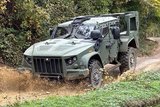
Oshkosh marked the handoff of the 1,000th MRAP All Terrain Vehicle (M-ATV) to the US Armed Forces on Nov 30 at a ceremony with military leadership at the company’s facilities in Oshkosh, Wis.
Brig. Gen. Michael Brogan, commander of the Marine Corps Systems Command, and Lt. Col. Coll Haddon, M-ATV product manager for the MRAP Joint Program Office, were the keynote speakers at the event. Having exceeded the government’s delivery schedule for five consecutive months, Oshkosh is ramping up production to 1,000 vehicles per month in December and continuing at that level through April 2010.
“We understood the urgency of the M-ATV program to save American lives and leaned forward in advance of receiving the contract to build vehicles and prepare our operations for this high-quantity production,” said Robert G. Bohn, Oshkosh Corporation chairman and chief executive officer. “Our workforce has embraced this important mission and made countless personal sacrifices to produce these vehicles quickly to protect those that are sacrificing for our safety. They will continue to deliver these life-saving vehicles along with replacement parts and field support, as long as necessary.”
Since being awarded the production contract on June 30, 2009, Oshkosh has received four additional awards from the US Army Tank-automotive and Armaments Command Life Cycle Management Command (TACOM LCMC) to supply a total of 6,219 M-ATVs. Oshkosh also has received orders for spare kits and to send its factory-trained field service representatives (FSR) to Afghanistan to provide training and maintenance support for the vehicles. The aggregate amount of the five awards is valued at $3.2 billion.
The M-ATV is the US military’s newest MRAP model, combining the protection levels of legacy MRAPs with improved mobility and durability to handle Afghanistan’s mountainous cross-country terrain and unimproved roads. The vehicle uses the Oshkosh-patented TAK-4 independent suspension system, which has undergone more than 500,000 miles of government testing, to achieve a 70-percent off-road profile capability and 16 inches of independent wheel travel. The system also is used on the Marine Corps’ Medium Tactical Vehicle Replacement (MTVR) and Logistics Vehicle System Replacement (LVSR), as well as the Army’s Palletized Load System (PLS A1).
Existing Oshkosh Defense manufacturing facilities have available production capacity for all current and pending military vehicle programs, including the M-ATV and the US Army’s Family of Medium Tactical Vehicles (FMTV), as well as any surges in production.
Oshkosh Defense teamed with Plasan North America to provide an advanced armor solution for the M-ATV. Plasan also developed the armor system used on more than 5,000 legacy MRAPs and thousands of Oshkosh MTVR Armored Cabs already in theater.



More from Land Warfare
-
![Trans-European iMUGS2 uncrewed systems programme set for three-day exercise in 2028]()
Trans-European iMUGS2 uncrewed systems programme set for three-day exercise in 2028
The next stage of the Integrated Modular Unmanned Ground System (iMUGS) programme, dubbed iMUGS2, was launched in November 2025. Three major demonstrations are planned before the end of 2028.
-
![How joint ventures are expanding Rheinmetall's munitions portfolio (video)]()
How joint ventures are expanding Rheinmetall's munitions portfolio (video)
Roman Köhne, CEO of Rheinmetall's Weapon and Ammunition Division, discusses the company's announcements at Eurosatory 2026, including developments in defence technology, precision systems, industrial partnerships and future capability programmes.
-
![Push strengthens for a second JLTV supplier]()
Push strengthens for a second JLTV supplier
A move, launched in May, could lead to a second supplier for the US Marines Corps’ Joint Light Tactical Vehicle requirement. Meanwhile, Wisconsin elected representatives have been pushing for necessary funding to be included in the FY27 budget.