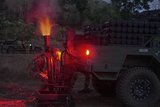
Ocelot Utility uses Marshall Land Systems Loadbed
The loadbed for the utility variant of the class leading light protected vehicle, Ocelot, is being provided by Marshall Vehicle Engineering (MVE), part of Cambridge based Marshall Land Systems.
The utility variant of Ocelot will soon be leaving for testing in the Australian Department of Defence’s Land 121 Phase 4 project for a protected mobility vehicle – light.
Ricardo plc, acting for Force Protection Europe, selected MVE to provide the loadbed based on its experience in providing over 4,500 load beds, so far, to the UK Ministry of Defence for the Support Vehicle programme, a further 1,500 remain to be delivered.
MVE has also delivered over 80 loadbeds to Ricardo and Force Protection for the Wolfhound Tactical Support Vehicle in service in Afghanistan. Marshall Vehicle Engineering’s loadbeds feature in a number of companies’ vehicle proposals around the world
“We are delighted to have been chosen to provide the loadbeds for the utility variant of Ocelot. This contract demonstrates that Marshall Vehicle Engineering has the experience to provide logistic solutions for use in harsh environments on both large and small vehicles,” said Peter Callaghan, Chief Executive of Marshall Land Systems.
The loadbed utilises a number of Marshall Military-off-the-Shelf (MOTS) components, including the drop sides and tail boards and was designed by Ricardo plc. As well as the loadbeds provided for Support Vehicle and Wolfhound, MVE has supplied loadbed systems to Iveco for the LMV and the Renault Sherpa Light.
Ocelot utility can carry palletised loads and loose stores in high threat areas and is suitable for both military and security users.
Ocelot’s successes in the UK LPPV competition and the early demonstration Phase of the Australian Land 121 Phase 4 programme, has generated wide international interest.
In the UK the first batch of vehicles, known as Foxhound by the British Army, will be delivered to the Army’s training fleet this year with full delivery of the first 200 scheduled to be completed by Spring 2012.
Source: Marshall Land Systems




More from Land Warfare
-
![Dominating the spectrum: ASELSAN’s EW capabilities take center stage at MSPO 2026]()
Dominating the spectrum: ASELSAN’s EW capabilities take center stage at MSPO 2026
ASELSAN is showcasing its advanced electronic warfare (EW) capabilities at MSPO 2026, highlighting technologies designed to detect, analyse, disrupt and deceive threats across increasingly contested electromagnetic environments.
-
![US Army set to receive first ISV-U-mounted Scorpion Light mortar]()
US Army set to receive first ISV-U-mounted Scorpion Light mortar
Global Military Products will begin deliveries next week under a US$12.9 million agreement covering digitally enabled 81mm mortar systems, vehicle integration and army fire-control technology.
-
![US Army reaches out to industry for M109 replacement in a deal worth up to $8 billion]()
US Army reaches out to industry for M109 replacement in a deal worth up to $8 billion
The US has tried several times to replace the M109 Paladin self-propelled howitzer, a requirement which Shephard forecasts could be for as many as 670 platforms and worth as much as US$8 billion.
-
![“Creating a decision advantage”: how C-UAS is evolving to reduce the operator burden]()
“Creating a decision advantage”: how C-UAS is evolving to reduce the operator burden
In Conversation… Speaking to Shephard’s Gerrard Cowan, Dr Brian Shand, Director – Advanced Concepts & Technology at L3Harris, explains how, as operators face growing numbers of low-cost drones, C-UAS providers must focus on reducing operator workload, transforming fragmented sensor data into effective decision-making.