Northrop Grumman teams with EOS Technologies on US Army’s CROWS 3
Northrop Grumman Corporation and EOS Technologies Inc. have teamed to pursue the US Army’s Common Remotely Operated Weapons Station 3 (CROWS 3) program.
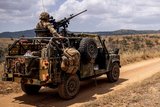
The CROWS vehicle-mounted stations allow soldiers to locate, identify and engage targets with better accuracy and improved range, while the gunner remains safely inside an armored vehicle.
Under the agreement announced today, Northrop Grumman will be the prime contractor and systems integrator if the team is selected for CROWS 3.
The US Army Tank-Automotive Research, Development and Engineering Center, Warren, Mich., is expected to release a request for proposals for approximately 10,000 CROWS 3 systems in late 2010. The Army plans to equip its entire inventory of tactical vehicles under the CROWS 3 program, making the total program worth as much as $4 billion.
EOS provided systems to the Army under the initial CROWS 1 contract and produces a weapon system that is compliant with both CROWS 1 and CROWS 2 requirements.
“Northrop Grumman and EOS have separately been pre-eminent suppliers of systems to the US Army for a considerable time,” said Joe G. Taylor, Jr., Northrop Grumman Information Systems’ vice president for ground combat systems. “Our team looks forward to working side-by-side with the Army to deliver this critical capability to soldiers.
“Collectively, we bring the proven experience, the latest technology and cultures of innovation and large-scale production to the Army’s effort to ensure that soldiers at all levels of the Army are able to operate effectively on the modern battlefield.”
Northrop Grumman has a long history of delivering complex integrated platforms to the Army, having fielded more than 1,000 platforms over the last 10 years. The company is the top supplier of command centers to the Army’s brigades and one of the largest suppliers to the US Defense Department.
EOS specializes in the design, development and production of remote weapon systems and space surveillance and missile defense systems. EOS’ advanced technologies are applied to a variety of sighting and surveillance applications in the aerospace and defense markets.
“The pooling of our companies’ technologies will provide higher product performance and more options to the customer, as well as easier integration of CROWS into the increasingly complex information and control systems used for weapon system deployment,” said Ben Greene, chief executive officer of EOS.
“Northrop Grumman’s proven, scalable production technology and its proven capability to provide weapon system support to US forces globally will clearly enhance EOS’ own capabilities. We are proud to combine our unmatched experience in remote weapons stations with Northrop Grumman’s complementary capabilities to deliver this important system to our forces in combat.”
As part of the teaming agreement, the companies have formed a single product development and production team to offer new technology products. EOS is also modifying its current production of remote weapon systems to include Northrop Grumman participation.
Source: Northrop Grumman





More from Land Warfare
-
![British Army Land Rover replacement plan inches forward]()
British Army Land Rover replacement plan inches forward
The UK Ministry of Defence has proposed a selection date of May 2027 for the Land Rover replacement requirement, with deliveries expected through to 2036. Next month’s DVD exhibition will be a key shop window for bidders.
-
![Snow patrol and access all areas: the Arctic all-terrain vehicles market grows]()
Snow patrol and access all areas: the Arctic all-terrain vehicles market grows
The procurement and planned procurement of articulated tracked all-terrain vehicles is being driven by a need to replace older platforms and an acknowledgement of a capability gap for Arctic regions.
-
![Push strengthens for a second JLTV supplier]()
Push strengthens for a second JLTV supplier
A move, launched in May, could lead to a second supplier for the US Marines Corps’ Joint Light Tactical Vehicle requirement. Meanwhile, Wisconsin elected representatives have been pushing for necessary funding to be included in the FY27 budget.
-
![Canada reveals first requirements for future long-range air-to-air missile]()
Canada reveals first requirements for future long-range air-to-air missile
Exclusive: Ottawa says its future NORAD interceptor must be highly stealthy, resistant to jamming and capable of engaging threats at very long range, while leaving the competition open to domestic and international suppliers.