New Russian-made APC en route


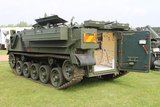
Russia’s KTZ concern has unveiled a brand-new tracked amphibious armoured personnel carrier (APC) developed from the the BMP-3 infantry fighting vehicle (IFV).
Designated as the BT-3F, it has reportedly been developed to satisfy an order placed by Indonesia but the manufacturer says that there is also a serious interest already expressed by the Russian military.
KTZ’s development department director, Sergey Kotelevsky claimed that the BT-3F was built to satisfy Indonesian requirements for getting an amphibious tracked APC. The Indonesian Marine Corps now operates some 54 BMP-3F IFVs delivered between 2010 and 2014, upgraded for amphibious operations.
This vehicle was
Our news & analysis is now part of Defence Insight®
A Basic-level or higher Defence Insight subscription is now required to view this content.


More from Land Warfare
-
![Dominating the spectrum: ASELSAN’s EW capabilities take center stage at MSPO 2026]()
Dominating the spectrum: ASELSAN’s EW capabilities take center stage at MSPO 2026
ASELSAN is showcasing its advanced electronic warfare (EW) capabilities at MSPO 2026, highlighting technologies designed to detect, analyse, disrupt and deceive threats across increasingly contested electromagnetic environments.
-
![US Army set to receive first ISV-U-mounted Scorpion Light mortar]()
US Army set to receive first ISV-U-mounted Scorpion Light mortar
Global Military Products will begin deliveries next week under a US$12.9 million agreement covering digitally enabled 81mm mortar systems, vehicle integration and army fire-control technology.
-
![US Army reaches out to industry for M109 replacement in a deal worth up to $8 billion]()
US Army reaches out to industry for M109 replacement in a deal worth up to $8 billion
The US has tried several times to replace the M109 Paladin self-propelled howitzer, a requirement which Shephard forecasts could be for as many as 670 platforms and worth as much as US$8 billion.
-
![“Creating a decision advantage”: how C-UAS is evolving to reduce the operator burden]()
“Creating a decision advantage”: how C-UAS is evolving to reduce the operator burden
In Conversation… Speaking to Shephard’s Gerrard Cowan, Dr Brian Shand, Director – Advanced Concepts & Technology at L3Harris, explains how, as operators face growing numbers of low-cost drones, C-UAS providers must focus on reducing operator workload, transforming fragmented sensor data into effective decision-making.