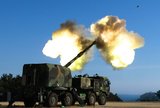
Latest version on Russia’s Sosna air defence system presented


The production version of the Sosna short-range mobile short-range air defence system (SHORAD) has been shown newly installed on a tracked chassis from the BMP-3 new-generation IFV at the Army-2019 defence exhibition held in Kubinka, Moscow.
During its unveiling to public in July 2018 the system was installed on an older-generation MT-LB tracked vehicle.
The system is a new development from the Nudelman Precise Machine-Building Design Bureau, a company controlled by the Rostec industrial conglomerate. It is touted as a successor of the Strela-10 (SA-13 Gopher) mobile SHORAD system while intended to counter a much wider range of low-level air
Our news & analysis is now part of Defence Insight®
A Basic-level or higher Defence Insight subscription is now required to view this content.

You may also like

More from Land Warfare
-
![Hanwha debuts with US Army deal worth up to $3.6 billion as it eyes future M109 replacement]()
Hanwha debuts with US Army deal worth up to $3.6 billion as it eyes future M109 replacement
The Mobile Tactical Cannon is to replace the US Army’s M777 towed howitzers which could result in the procurement of almost 500 systems at an estimated $3.59 billion.
-
![US pours another $23 billion into Arsenal of Freedom to ramp up missile production]()
US pours another $23 billion into Arsenal of Freedom to ramp up missile production
The US Department of Defense (DoD) is spending billions of dollars to accelerate missile production to meet demands from the war against Iran and requirements in Ukraine. Manufacture of SM-3 and PAC-3 interceptors is being ramped up, alongside a $22.9 billion commitment to Tomahawk cruise missiles.
-
![Rheinmetall advances longer 155mm ordnance with 30% range increase]()
Rheinmetall advances longer 155mm ordnance with 30% range increase
Rheinmetall has begun initial firing trials of a new 155mm/60-calibre artillery ordnance that could deliver up to 30% greater range than its existing 155mm/52-calibre system, as production of the current gun expands across Germany and the UK.
-
![Trans-European iMUGS2 uncrewed systems programme set for three-day exercise in 2028]()
Trans-European iMUGS2 uncrewed systems programme set for three-day exercise in 2028
The next stage of the Integrated Modular Unmanned Ground System (iMUGS) programme, dubbed iMUGS2, was launched in November 2025. Three major demonstrations are planned before the end of 2028.