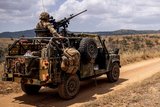
Kongsberg to deliver C-UAS capability to USMC
KONGSBERG will deliver RS6 RWS for MADIS programme (Imagine: Kongsberg)
The USMC has awarded an IDIQ production contract for RWS under the MADIS programme.


Kongsberg Protech Systems USA has been awarded a production contract by the USMC to deliver remote weapon systems (RWS) as part of the Marine Air Defense Integrated System (MADIS) programme.
The IDIQ contract has a ceiling of $94 million and includes a series of Low-Rate Initial Production (LRIP) systems and full-rate production units.
The Kongsberg RS6 RWS for MADIS leverages technology and competence drawn from multiple C-UAS and air defence programmes. The system has commonality with the family of Protector RWS delivered and fielded with the US Army and marine corps and will be integrated on the Joint Light Tactical Vehicle together with external sensors and effectors.
The RS6 includes an XM914E1 30x113mm DC driven cannon with a coaxial M240 7.62mm machine gun, an integration kit for the Stinger Air-To-Air Launcher (ATAL) and provisions for future C-UAS defeat systems.
Related Equipment in Defence Insight

You may also like
More from Land Warfare
-
![Hanwha debuts with US Army deal worth up to $3.6 billion as it eyes future M109 replacement]()
Hanwha debuts with US Army deal worth up to $3.6 billion as it eyes future M109 replacement
The Mobile Tactical Cannon is to replace the US Army’s M777 towed howitzers which could result in the procurement of almost 500 systems at an estimated $3.59 billion.
-
![US pours another $23 billion into Arsenal of Freedom to ramp up missile production]()
US pours another $23 billion into Arsenal of Freedom to ramp up missile production
The US Department of Defense (DoD) is spending billions of dollars to accelerate missile production to meet demands from the war against Iran and requirements in Ukraine. Manufacture of SM-3 and PAC-3 interceptors is being ramped up, alongside a $22.9 billion commitment to Tomahawk cruise missiles.
-
![Rheinmetall advances longer 155mm ordnance with 30% range increase]()
Rheinmetall advances longer 155mm ordnance with 30% range increase
Rheinmetall has begun initial firing trials of a new 155mm/60-calibre artillery ordnance that could deliver up to 30% greater range than its existing 155mm/52-calibre system, as production of the current gun expands across Germany and the UK.
-
![Trans-European iMUGS2 uncrewed systems programme set for three-day exercise in 2028]()
Trans-European iMUGS2 uncrewed systems programme set for three-day exercise in 2028
The next stage of the Integrated Modular Unmanned Ground System (iMUGS) programme, dubbed iMUGS2, was launched in November 2025. Three major demonstrations are planned before the end of 2028.
-
![British Army Land Rover replacement plan inches forward]()
British Army Land Rover replacement plan inches forward
The UK Ministry of Defence has proposed a selection date of May 2027 for the Land Rover replacement requirement, with deliveries expected through to 2036. Next month’s DVD exhibition will be a key shop window for bidders.