Italy enlists Milrem to aid land robotics roadmap
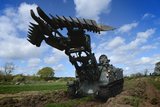
Milrem Robotics manufactures the THeMIS UGV. (Photo: Milrem Robotics)
Milrem Robotics will help the Italian Army to develop a clear path to how remote autonomous vehicles and architectures can generate operational advantages for troops in urban operations.


An Italian Army programme will be supported by Milrem Robotics under a contract from the NATO Support and Procurement Agency.
Estonia-based Milrem will provide concept development and experimentation (CD&E) services in a multi-year effort, as the Italian Army works to update its remote autonomous systems (RAS) strategy and outline an implementation roadmap for the introduction of unmanned ground systems and related technologies.
Milrem stated on 13 January that it will support the Italian Army in developing a clear path to how RAS technology, systems and architectures can generate operational advantages for troops operating in urbanised environments.
Deliverables will include a C2 system, an autonomy engine, systems integration of third-party capabilities, several unmanned ground and air vehicles and a variety of sensors and effectors.
‘This programme is well in line with our core competencies as a system integrator for autonomous and robotic technologies,’ said Kuldar Väärsi, CEO of Milrem Robotics.
At the CD&E stage, Milrem added, the Italian Army aims to exploit prototyping skills and technological capabilities to demonstrate future operational benefits, with the broader objective of identifying ‘transformational initiatives’ over the next five to 15 years for the development of operational RAS capabilities.


More from Land Warfare
-
![How to breach a minefield: from traditional systems to modern techniques in action]()
How to breach a minefield: from traditional systems to modern techniques in action
The news from Ukraine has again shown that antitank minefields and other obstacles on the battlefield, such as deep trenches, can play a key role in both offensive and defensive operations. Given this, there will always be a need to clear them, both during and after a conflict.
-
![British Army's open plan draws diverse offerings for Land Rover replacement]()
British Army's open plan draws diverse offerings for Land Rover replacement
The UK Ministry of Defence has avoided being prescriptive in its search to replace the British Army’s Land Rover, meaning vehicle types being offered range from Land Rover Defender Wolf II and Humvee to the hybrid series Fering Pioneer. What does this mean for the procurement process?
-
![DVD 2026: British Army’s Ajax back in the hands of users as part of a gradual return]()
DVD 2026: British Army’s Ajax back in the hands of users as part of a gradual return
The introduction of Ajax vehicles into British Army service was stopped after operator health issues were reported during an exercise, but manufacturer General Dynamics Land Systems UK believes work over the past 10 months has dealt with the problems.
-
![Europe commits to long-range fires but countries move in different directions]()
Europe commits to long-range fires but countries move in different directions
Sweden, Croatia and France are pursuing different rocket artillery solutions as European armies seek greater reach, survivability and industrial resilience.
-
![Polaris expands Arctic mobility offering as US military orders grow]()
Polaris expands Arctic mobility offering as US military orders grow
The Military 850 Voyageur 155 Crossover has secured orders from the US Army, Air Force and Marine Corps, addressing demand for agile Arctic mobility with passenger, cargo and towing capacity.