Israel set to order more JLTVs and missile boats
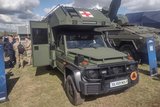
Israel received its first JLTVs in March. (Photo: Israeli MoD)
The Nagel Committee has been established to examine defence spending and IDF military force design for the future in the wake of last year’s 7 October Hamas attack on Israel.


Israel Military Procurement Ministerial Committee has approved the purchase of hundreds of additional Joint Light Tactical Vehicles (JLTVs) and Reshef fast attack craft which will replace Sa’ar 4.5-class ships which are being decommissioned.
The purchases were recommended by the Nagel Committee which was established after the attack on Israel by Hamas forces on 7 October last year and will now be sent to the Knesset’s Joint Committee for the Defence Budget for approval. Once approved, the Israeli Minister of Defence (MoD) will begin contract negotiations.
The value of the contracts has yet to be finalised but Shephard Defence
Our news & analysis is now part of Defence Insight®
A Basic-level or higher Defence Insight subscription is now required to view this content.



More from Land Warfare
-
![Europe commits to long-range fires but countries move in different directions]()
Europe commits to long-range fires but countries move in different directions
Sweden, Croatia and France are pursuing different rocket artillery solutions as European armies seek greater reach, survivability and industrial resilience.
-
![MAAF to test Britain’s shift from armour to distributed lethality in Estonia]()
MAAF to test Britain’s shift from armour to distributed lethality in Estonia
The bilateral agreement between the UK and Estonia comes as both countries explore how dispersed troops, drones, digital targeting, anti-tank weapons and increasingly long-range fires can complement the combat mass traditionally provided by heavy armour.
-
![Polaris expands Arctic mobility offering as US military orders grow]()
Polaris expands Arctic mobility offering as US military orders grow
The Military 850 Voyageur 155 Crossover has secured orders from the US Army, Air Force and Marine Corps, addressing demand for agile Arctic mobility with passenger, cargo and towing capacity.
-
![More bidders move onto starting grid for British Army Land Rover replacement programme]()
More bidders move onto starting grid for British Army Land Rover replacement programme
The Light Mobility Vehicle segment of the UK’s Land Mobility Programme for the British Army may actually be about to make progress, or at least likely bidders seem to think so. Shephard spoke with several contenders who revealed their views on how the army should replace the ageing fleet.