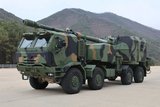
Insight: The lay of military land procurement in 2018


Armoured vehicles, tanks and artillery pieces are creeping back to the front of modern warfare and near peer threats now dominate the security landscape many nations are quickly introducing new and upgraded vehicles into their inventory.
Many nations that are now pouring money into improvement and modernisation of their land forces and air defence capabilities are in Eastern Europe which are more than aware of a neighbouring threat, especially since Russia’s annexation of Crimea in 2014.
Raytheon’s Patriot air defence system saw success in both Romania and Poland in 2018 through FMS via the US government. Raytheon received the order
Our news & analysis is now part of Defence Insight®
A Basic-level or higher Defence Insight subscription is now required to view this content.



More from Land Warfare
-
![How laser weapons could transform the economics of European air defence (Podcast)]()
How laser weapons could transform the economics of European air defence (Podcast)
Former UK Defence Secretary Lord John Hutton examines how drones, missiles, laser weapons and procurement pressures are reshaping European air defence.
-
![The US DoD’s counter-drone marketplace begins to produce results]()
The US DoD’s counter-drone marketplace begins to produce results
The Pentagon's push to accelerate counter-drone procurement is opening new opportunities for defence companies as it seeks to bring emerging technologies into operational service more quickly.
-
![AUSA 2026: Hanwha receives howitzer top-up order to meet US Army’s fast delivery demand]()
AUSA 2026: Hanwha receives howitzer top-up order to meet US Army’s fast delivery demand
Less than two months after winning a contract from the US Army for six prototype K9 mobile howitzers, Hanwha Defense USA has received an order for another three. The company will show a platform at AUSA 2026.
-
![AUSA 2026 preview: Uncrewed systems and platforms to defend against them set to feature]()
AUSA 2026 preview: Uncrewed systems and platforms to defend against them set to feature
The Association of the US Army’s flagship conference and exhibition takes place in Washington, DC from 12 to 14 October. Shephard takes a look at what might be in store at the 2026 show, with uncrewed and counter-uncrewed systems and platforms under the spotlight.
-
![“A survivable architecture”: why resilient communications are no longer a luxury]()
“A survivable architecture”: why resilient communications are no longer a luxury
In Conversation… Military communications must adapt to a rapidly evolving battlespace, characterised by decentralised forces and an increasingly contested electromagnetic spectrum. To survive and thrive, it is vital to prioritise resilient systems and networks, Faisal Munir, President – Mission-Critical Communications at L3Harris Technologies, told Shephard’s Gerrard Cowan.