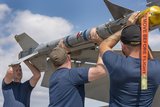
HII awarded contract to support US ground vehicles
The contract will focus on vehicle power and mobility. (Photo: US Army)
The Department of Defense Information Analysis Center (DoDIAC) provides technical data management and research support for vehicle users. The HII contract will focus on ground combat systems and service lifecycle efforts.


HII will support the enhancement of power and mobility of vehicles in service with US forces under a US$197 million contract in support of the US Army Combat Capabilities Development Command’s Ground Vehicle Systems Center (CCDC GVSC).
The contract is to the company’s Mission Technologies division and was awarded by the US Air Force’s 774th Enterprise Sourcing Squadron under the DoDIAC multiple-award contract vehicle.
This and similar contracts are to develop and create new knowledge for the enhancement of the Defense Technical Information Center repository, and the research and development, and science and technology communities.
Under the contract HII will research and develop enhancements for GVSC’s ground combat systems and service lifecycle efforts.
There will be an emphasis on vehicle power and mobility, and the research will apply to the full suite of army vehicles, from manned and unmanned ground combat vehicles to hybrid, joint light tactical and robotic vehicles.
GVSC has contracted for a range of efforts to improve and maintain vehicle capability.
In May 2024, the army awarded Concurrent Technologies a $13 million contract to help reduce the weight and improve survivability of combat vehicles and effort led by the GVSC.
This initiative covers efforts to develop and apply advanced materials and manufacturing processes with the aid of machine learning.
In September 2022, American Rheinmetall Vehicles signed a cooperative agreement with the CCDC GVSC to develop integrated combat vehicle suspension, track and running gear technologies.


More from Land Warfare
-
![How joint ventures are expanding Rheinmetall's munitions portfolio (video)]()
How joint ventures are expanding Rheinmetall's munitions portfolio (video)
Roman Köhne, CEO of Rheinmetall's Weapon and Ammunition Division, discusses the company's announcements at Eurosatory 2026, including developments in defence technology, precision systems, industrial partnerships and future capability programmes.
-
![Canada reveals first requirements for future long-range air-to-air missile]()
Canada reveals first requirements for future long-range air-to-air missile
Exclusive: Ottawa says its future NORAD interceptor must be highly stealthy, resistant to jamming and capable of engaging threats at very long range, while leaving the competition open to domestic and international suppliers.
-
![July land forces roundup: UK outlines spending with details unveiled on Eurosatory vehicles]()
July land forces roundup: UK outlines spending with details unveiled on Eurosatory vehicles
Analysis of the long-awaited UK Defence Investment Plan, which was finally released on 30 June, revealed scant investment in platform replacement for the British Army. The bright spot in July, however, was a multibillion-dollar contract awarded for the British Army’s Collective Training System.