Harris communications selected for Brazilian SISFRON programme


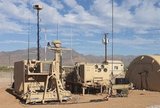
Harris has been selected by Savis to supply an end-to-end tactical communications system for the Brazilian armed forces border security programme, SISFRON. The solution will be based on Harris wideband radios with tactical voice, situational awareness and surveillance capabilities.
Savis is part of the Tepro consortium which is carrying out Phase 1 of the SISFRON programme on behalf of the Brazilian Army under a $404 million contract awarded in November 2012. The SISFRON programme will see an Integrated Border Monitoring System developed along the Western borders of Brazil, with Phase 1 focusing on providing surveillance and protection across approximately 650 kilometers of Brazilian border territory.
Harris will supply tactical communications subsystems, accessories, software, services and support for this phase. These radios deliver live video, tactical chat, and situational awareness to the lowest echelons.
Dana Mehnert, group president, Harris RF Communications, said: ‘Harris solutions will enable secure real-time voice, situational awareness and video communications across all echelons and provide border security forces with unprecedented command and control capability. This important programme significantly expands our presence with the Brazilian Army in support of their communications modernization requirements.’
In April, Elbit Systems’ Brazilian subsidiary, AEL International, was selected to supply electro-optic (EO) observation systems to Savis as part of the first phase of the programme.


More from Land Warfare
-
![Tulpar firing trials expand Hitfact Mk II platform options]()
Tulpar firing trials expand Hitfact Mk II platform options
Firing trials of the Tulpar and Leonardo Hitfact Mk II combination follow an integration programme covering mechanical, electrical, electronic and software interfaces.
-
![How to breach a minefield: from traditional systems to modern techniques in action]()
How to breach a minefield: from traditional systems to modern techniques in action
The news from Ukraine has again shown that antitank minefields and other obstacles on the battlefield, such as deep trenches, can play a key role in both offensive and defensive operations. Given this, there will always be a need to clear them, both during and after a conflict.
-
![British Army's open plan draws diverse offerings for Land Rover replacement]()
British Army's open plan draws diverse offerings for Land Rover replacement
The UK Ministry of Defence has avoided being prescriptive in its search to replace the British Army’s Land Rover, meaning vehicle types being offered range from Land Rover Defender Wolf II and Humvee to the hybrid series Fering Pioneer. What does this mean for the procurement process?
-
![DVD 2026: British Army’s Ajax back in the hands of users as part of a gradual return]()
DVD 2026: British Army’s Ajax back in the hands of users as part of a gradual return
The introduction of Ajax vehicles into British Army service was stopped after operator health issues were reported during an exercise, but manufacturer General Dynamics Land Systems UK believes work over the past 10 months has dealt with the problems.
-
![Europe commits to long-range fires but countries move in different directions]()
Europe commits to long-range fires but countries move in different directions
Sweden, Croatia and France are pursuing different rocket artillery solutions as European armies seek greater reach, survivability and industrial resilience.
-
![MAAF to test Britain’s shift from armour to distributed lethality in Estonia]()
MAAF to test Britain’s shift from armour to distributed lethality in Estonia
The bilateral agreement between the UK and Estonia comes as both countries explore how dispersed troops, drones, digital targeting, anti-tank weapons and increasingly long-range fires can complement the combat mass traditionally provided by heavy armour.