General Atomics completes railgun and powder gun testing contract
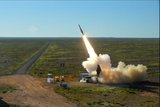
General Atomics worked closely with the Navy’s Dahlgren Division, using equipment like this railgun. (Photo: US Navy)
General Atomics has announced further success with the development of gun-launched projectile designs.


General Atomics Electromagnetic Systems (GA-EMS) with the US Army and Navy have completed a major test series to advance the state-of-the-art in gun-launched defensive projectile interceptor designs.
Identical projectile designs were fired from a railgun at White Sands Missile Range in New Mexico and a powder gun at Dugway Proving Ground in Utah.
The projectiles reached record hypersonic velocities from the railgun launch and tested the projectiles’ guided flight capabilities from both gun systems.
General Atomics delivered the projectiles with integrated gun-hardened guidance electronics to test their capability to sustain data links and control trajectory while the projectiles undergo intense G-Forces at hypersonic speeds.
The projectiles were developed to contain guidance electronics and control actuation systems.
During the test, the projectiles were launched using the Navy’s 32-megajoule railgun system and a 120mm powder gun.
Scott Forney, president of GA-EMS, commented that with these tests: ‘We have completed our contract to fabricate, deliver, and test prototype projectiles in railgun and powder gun environments’.




More from Land Warfare
-
![Europe’s eastern flank moves on air defence radars with wider efforts also underway]()
Europe’s eastern flank moves on air defence radars with wider efforts also underway
Air defence radars have become more important assets in the past year with incursions in NATO countries on Europe’s eastern flank highlighting the need.
-
![Australia’s SM-2 land trial could reshape ADF medium-range air defence plans]()
Australia’s SM-2 land trial could reshape ADF medium-range air defence plans
The first ground launch of the SM-2 could offer Canberra a path to expand its missile defence capability by adapting systems already fielded across the ADF.
-
![New teams form to compete for British Army Land Rover replacement]()
New teams form to compete for British Army Land Rover replacement
The UK’s Land Mobility Programme Light Mobility Vehicle requirement is designed to replace the British Army’s ageing fleet of Land Rovers with a vehicle with a Gross Vehicular Mass of less than 3,500kg. It could be for as many as 6,000 vehicles.
-
![FIA 2026: MBDA launches low-cost interceptor for short-range air defence]()
FIA 2026: MBDA launches low-cost interceptor for short-range air defence
At FIA 2026, MBDA launched its Counter Mass Interceptor (CMI) which the company says is a mass-producible, low-cost effector for fire-and-forget engagements at range and altitude.