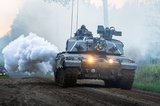
GDLS to continue Stryker ECP upgrade R&D work


General Dynamics Land Systems (GDLS) will continue research, development and testing work in preparation for the Stryker Engineering Change Proposal (ECP) upgrade programme under a new contract announced on 4 December. The company was awarded a $28 million contract for the work by the US Army TACOM Contracting Command.
The Stryker ECP upgrade programme is an engineering-development effort focused on integrating a group of system improvements into a single upgrade programme for the Stryker eight-wheeled vehicle. Technical upgrades to the Stryker will include improved automotive and electrical power generation, chassis upgrades and improved vehicle network capabilities.
GDLS’ work will focus on understanding how the Stryker vehicles can be prepared to accept additional army-directed requirements in the future without impacting current vehicle performance. There is no production work associated with this award.
Gordon Stein, vice president for Stryker Brigade Combat Teams, GDLS, said: ‘This award shows the army’s long-term commitment to improving Stryker capabilities for the warfighter, while ensuring that platforms are able to integrate planned and future upgrades. This effort will maintain the Stryker’s position as the army’s primary medium combat vehicle.’
The contract will run through to November 2018.
Related Equipment in Defence Insight


More from Land Warfare
-
![Europe commits to long-range fires but countries move in different directions]()
Europe commits to long-range fires but countries move in different directions
Sweden, Croatia and France are pursuing different rocket artillery solutions as European armies seek greater reach, survivability and industrial resilience.
-
![MAAF to test Britain’s shift from armour to distributed lethality in Estonia]()
MAAF to test Britain’s shift from armour to distributed lethality in Estonia
The bilateral agreement between the UK and Estonia comes as both countries explore how dispersed troops, drones, digital targeting, anti-tank weapons and increasingly long-range fires can complement the combat mass traditionally provided by heavy armour.
-
![Polaris expands Arctic mobility offering as US military orders grow]()
Polaris expands Arctic mobility offering as US military orders grow
The Military 850 Voyageur 155 Crossover has secured orders from the US Army, Air Force and Marine Corps, addressing demand for agile Arctic mobility with passenger, cargo and towing capacity.