FNSS show latest Pars IV 6x6 vehicle at IDEF
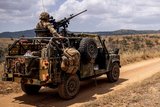
Latest Pars IV (6x6) in Special Operations Vehicle configuration with added net protection system against rocket-propelled grenades (Photo: Author)
At IDEF 2023, FNSS Suvunma Sistemleri is showcasing the Pars IV (6x6) Special Operational Vehicle (SOV), which is now being deployed by the Türkiye’s Army Special Forces Command.


The Pars IV is armed with two FNSS-developed Sancak remote-controlled weapon stations (RCWS) armed with a 12.7 mm stabilised machine gun (MG) fed from the left and a stabilised day/night sensor pod, which also includes a laser rangefinder on the right.
Alternative weapon fits for the Sancak RCWS include a 7.62 mm MG or a 40 mm automatic grenade launcher (AGL).
The vehicle also features counter-IED equipment and an Aselsan acoustic gunfire detection system.
Mounted on the roof at the rear on the right side is a UAV to provide additional reconnaissance capability.
The hull is of all welded steel
Our news & analysis is now part of Defence Insight®
A Basic-level or higher Defence Insight subscription is now required to view this content.

More from Land Warfare
-
![Rheinmetall advances longer 155mm ordnance with 30% range increase]()
Rheinmetall advances longer 155mm ordnance with 30% range increase
Rheinmetall has begun initial firing trials of a new 155mm/60-calibre artillery ordnance that could deliver up to 30% greater range than its existing 155mm/52-calibre system, as production of the current gun expands across Germany and the UK.
-
![Trans-European iMUGS2 uncrewed systems programme set for three-day exercise in 2028]()
Trans-European iMUGS2 uncrewed systems programme set for three-day exercise in 2028
The next stage of the Integrated Modular Unmanned Ground System (iMUGS) programme, dubbed iMUGS2, was launched in November 2025. Three major demonstrations are planned before the end of 2028.
-
![How joint ventures are expanding Rheinmetall's munitions portfolio (video)]()
How joint ventures are expanding Rheinmetall's munitions portfolio (video)
Roman Köhne, CEO of Rheinmetall's Weapon and Ammunition Division, discusses the company's announcements at Eurosatory 2026, including developments in defence technology, precision systems, industrial partnerships and future capability programmes.