Escribano presents Pizarro Phase II’s driving cameras
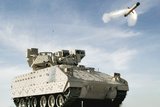
Pizzaro equipped with Escribano's camera (Photo - Escribano)
The devices are a high-reliability solution adaptable for light, unmanned and armoured vehicles.


Spanish company Escribano on 20 September presented new driving cameras for Phase II Pizarro armoured vehicles for the Spanish Army.
The highly reliable devices are adaptable for light, unmanned and armoured vehicles, Escribano claimed in a press release.
It added that the systems have a modular design that allows easy maintenance in addition to improved situational awareness and increased safety.
The driving cameras have daylight and IR sensors and display HD images under extreme environmental conditions for both day and night operations in a rugged 8.4in (21.3cm) HD monitor which features high-contrast and night vision modes.
The cameras were acquired in October 2020 under a €2million ($2.34 million) contract for 83 units.
Shephard Defence Insight notes that Pizarro IFV-2 was built to meet a Spanish requirement for a medium-weight armoured vehicle that combined survivability, mobility, reliability and firepower.
Related Equipment in Defence Insight



More from Land Warfare
-
![AUSA 2026: companies adapt munitions and missiles for greater effect at lower costs]()
AUSA 2026: companies adapt munitions and missiles for greater effect at lower costs
Rather than developing entirely new weapons, defence companies are looking to build on existing weapons and systems to deliver greater capability, control costs and accelerate fielding.
-
![With changing patterns in Middle Eastern procurement, is Europe missing out?]()
With changing patterns in Middle Eastern procurement, is Europe missing out?
Traditional suppliers are struggling to meet the Middle East’s armoured vehicle modernisation needs, creating opportunities for South Korean manufacturers and regional defence industries.
-
![AUSA 2026: CUAS market expands as suppliers target new threats and operational requirements]()
AUSA 2026: CUAS market expands as suppliers target new threats and operational requirements
New developments from MARSS, MyDefence, Mountain Horse Solutions and Rafael suggest that future counter-drone protection will increasingly depend on combining advanced detection, rapid interception and integrated defensive networks.