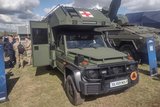
Engineering and design mean smaller vehicles can be tank killers but is it a good idea?
An FNSS Pars 4x4 launches a Kornet-EM ATGM, a capability being increasingly added to smaller wheeled vehicles. (Photo: FNSS)
The eulogy for the dedicated tank hunter or buster appears to have been written with most armies putting them out to retirement in the face of alternatives like longer-range missiles or uncrewed aerial systems (UAS). However, arming infantry fighting vehicles (IFVs) or armoured personnel carriers (APCs) with medium-range missiles seems to indicate some kind of tank killer is required.


Introducing tank killer capability to IFVs and APCs, or even smaller vehicles, can add a capability without the need for an extra fleet of vehicles and it is an option now being picked up by most forces.
While adding two pods of anti-tank guided weapons (ATGWs) onto the latest turrets is a common design, consideration still needs to be given to whether it is necessary, as the total cost goes beyond just the missile.
Adding ATGMs to counter threats such as main battle tanks (MBTs) can deal with the large platforms which cannot be neutralised by the IFV’s primary armament, normally a 20-40mm cannon. This can
Our news & analysis is now part of Defence Insight®
A Basic-level or higher Defence Insight subscription is now required to view this content.



More from Land Warfare
-
![British Army's open plan draws diverse offerings for Land Rover replacement]()
British Army's open plan draws diverse offerings for Land Rover replacement
The UK Ministry of Defence has avoided being prescriptive in its search to replace the British Army’s Land Rover, meaning vehicle types being offered range from Land Rover Defender Wolf II and Humvee to the hybrid series Fering Pioneer. What does this mean for the procurement process?
-
![DVD 2026: British Army’s Ajax back in the hands of users as part of a gradual return]()
DVD 2026: British Army’s Ajax back in the hands of users as part of a gradual return
The introduction of Ajax vehicles into British Army service was stopped after operator health issues were reported during an exercise, but manufacturer General Dynamics Land Systems UK believes work over the past 10 months has dealt with the problems.
-
![Europe commits to long-range fires but countries move in different directions]()
Europe commits to long-range fires but countries move in different directions
Sweden, Croatia and France are pursuing different rocket artillery solutions as European armies seek greater reach, survivability and industrial resilience.