Dutch ditch Mercedes-Benz air assault vehicle deal
11 Airmobile Brigade (pictured on exercise) would have been a major recipient of the 12kN air assault vehicle. (Photo: Netherlands MoD)
Will Germany come to the rescue after the Netherlands had to cancel a contract for 515 air assault vehicles?


The Dutch MoD on 18 November announced the cancellation of a contract with Mercedes-Benz Netherlands for 12kN air assault vehicles.
Mercedes-Benz Netherlands had won a contract ahead of competition from Defenture and Jankel in October 2018 for 515 vehicles but the MoD noted in an 18 November statement that the programme ‘was already facing delays’ and the company ‘cannot fulfil the contract’.
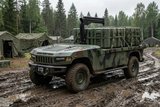
Mercedes-Benz was to develop G-Class 300 CDI vehicles to fit in a Chinook or underslung. ‘In addition,’ the MoD noted, ‘the vehicles had to be able to carry sufficient cargo and also be sufficiently protected against, for example, artillery threats. This complex combination of factors turned out not to be feasible for the supplier.’
The MoD held talks with Mercedes-Benz to explore potential solutions but it stated that ‘this was not possible within the financial agreements made’.
After giving the contractor a final opportunity in October 2021 to confirm it could meet the requirements of the contract within the agreed price, the MoD decided to terminate the deal.
Mercedes-Benz had been due to start deliveries of the new 12kN vehicles in 2021, in three variants: combat (329 vehicles), logistics (144) and casevac (42).
With the termination of the 12kN deal, the Netherlands is left with a gap to fill for its 11 Airmobile rapid light infantry brigade that operates within the German Rapid Forces Division.
The MoD stated that it ‘is entering into talks’ with a view to joining the German Bundeswehr Airborne Platform programme, a tender for which is expected in 2023. However, this would see initial deliveries only in 2027.
‘In the intervening period, the Airmobile Brigade must continue to have vehicles at its disposal,’ the MoD admitted, adding that it is ‘investigating the possibilities for this and will provide more clarity about an interim solution before the end of the year [2021]’.
Related Programmes in Defence Insight

You may also like

More from Land Warfare
-
![Clearer military requirements could unlock UGV market growth]()
Clearer military requirements could unlock UGV market growth
Western armies continue to test uncrewed ground vehicles, but wider procurement will depend on turning ambitions for autonomy into defined operational roles and funded requirements.
-
![Can NATO’s CUAS marketplace turn urgent demand into deliveries?]()
Can NATO’s CUAS marketplace turn urgent demand into deliveries?
Framework contracts and leasing options aim to shorten acquisition timelines, while manufacturing partnerships could help suppliers scale production to meet allied demand.
-
![A medium UGV market emerges as the US weighs up its options]()
A medium UGV market emerges as the US weighs up its options
The US is pursuing multiple UGV programmes, from commercial robotic platforms to new autonomy technologies. The combination of these efforts could prove key to turning ambition into operational capability.
-
![NATO looks for answers to overcome standards hurdles and improve procurement]()
NATO looks for answers to overcome standards hurdles and improve procurement
NATO is looking to artificial intelligence to provide integration between different C2 systems to create a common operational picture, potentially offering a faster route to interoperability than the slow-moving processes of NATO standards committees.
-
![NATO FUSE exercise plays out real-world scenario in the face of eastern border risks]()
NATO FUSE exercise plays out real-world scenario in the face of eastern border risks
The large-scale exercise in Latvia was the culmination of three experimentation initiatives to see how platforms, weapons and systems could fit into the alliance’s Eastern Flank Deterrence Initiative. As well as forces, it brought together companies and equipment.
-
![Canada accelerates uncrewed aerial system procurement for NATO and Arctic forces]()
Canada accelerates uncrewed aerial system procurement for NATO and Arctic forces
Canada plans to acquire at least 120 uncrewed aerial systems through two competitions with combined funding ceilings of C$32 million.