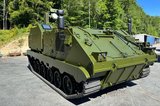
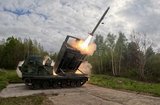
DeepStrike passes critical test


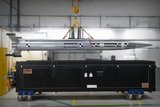
Raytheon’s new DeepStrike missile rocket motor passed a static test conducted at the Allegany Ballistics Laboratory in West Virginia, the company announced on 23 April.
The successful test moved the advanced, surface-to-surface weapon closer to its maiden flight test planned later in 2019.
The new, long-range precision strike missile features two-in-the-pod design and is highly manoeuvrable. It has a modular, open architecture to simplify system upgrades. The missile will be able to defeat fixed land targets 60-499km away.
The company is offering the DeepStrike missile for the US Army’s Precision Strike Missile programme to replace the army tactical missile system that is approaching the end of its service life.
Thomas Bussing, VP, advanced missile systems, Raytheon, said: ‘Testing shows us how initial data assessments line up and validates them for the next phase in development. This test confirms our design for the DeepStrike propulsion system is solid and moves us one step closer to extending the army’s reach and doubling the load-out of long-range fires.’
Raytheon has already concluded a successful preliminary design review for the weapon.

More from Land Warfare
-
![“Timelines are measured in seconds”: tackling the UAS threat with dispersed defences]()
“Timelines are measured in seconds”: tackling the UAS threat with dispersed defences
Small uncrewed aerial systems (UAS) have transformed the battlespace, posing a complex threat across all domains. Militaries now need counter-UAS (CUAS) capabilities that defeat the danger while meeting demands around readiness, manoeuvrability and adaptability, according to Mike Spina, Director, Global Sales and Business Development for Targeting and Sensor Systems (TSS) at L3Harris Technologies.
-
![“No single technology is enough”: why an integrated approach to uncrewed warfare is essential]()
“No single technology is enough”: why an integrated approach to uncrewed warfare is essential
In Conversation… Ahmet Akyol, CEO of ASELSAN, talks to Shephard’s Gerrard Cowan about how the rapid evolution of uncrewed aerial systems (UAS) is transforming the battlespace, with militaries focused on both deploying these platforms to maximum effect and developing the defensive systems needed to counter them.
-
![Lasers heat up for counter-drone option as DroneLight tackles the big question]()
Lasers heat up for counter-drone option as DroneLight tackles the big question
Using lasers to defeat drones promises to solve the dilemma of using expensive kinetic effects to kill platforms worth a few hundred dollars. While maintaining thermal output to provide the effects can be a technical hurdle, Israel’s Esh-Tech is one company working on a solution.
-
![How Pearson Engineering combines tradition with innovation for the demining mission (Video)]()
How Pearson Engineering combines tradition with innovation for the demining mission (Video)
At Eurosatory 2026, Pearson Engineering's Group CEO Ian Bell talked about the company's role in delivering specialist armoured engineering, route-clearance and demining capabilities to military customers around the world.