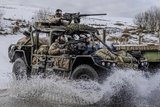
Curtiss-Wright TDSS for Scout SV


Curtiss-Wright has been awarded a contract from Lockheed Martin to provide the Turret Drive Servo System (TDSS) for the British Army’s new Scout Specialist Vehicle (SV), the company announced on 16 July.
The TDSS will provide weapon stabilisation for the Scout, which is set to replace the army’s Scimitar combat vehicle. The contract is valued at around $49 million.
The contract award follows Curtis-Wright’s completion of the $13 million demonstration phase for the programme, which began in 2010. Under the new award, the company will begin shipping the TDSS in 2015 and continue through to 2021.
The TDSS will be delivered to Lockheed Martin, which will integrate them onto the turrets at their Ampthill, UK manufacturing facility.
David Adams, chairman and CEO, Curtiss-Wright, said: ‘Curtiss-Wright is proud to have been selected by Lockheed Martin to provide our electromechanical aiming and stabilisation system for use on the Scout reconnaissance vehicle.
‘As a leader in the design and development of rugged turret drive systems for military vehicles, we are pleased to participate in this important programme for the UK’s Ministry of Defence.’
Related Equipment in Defence Insight


More from Land Warfare
-
![Europe commits to long-range fires but countries move in different directions]()
Europe commits to long-range fires but countries move in different directions
Sweden, Croatia and France are pursuing different rocket artillery solutions as European armies seek greater reach, survivability and industrial resilience.
-
![Polaris expands Arctic mobility offering as US military orders grow]()
Polaris expands Arctic mobility offering as US military orders grow
The Military 850 Voyageur 155 Crossover has secured orders from the US Army, Air Force and Marine Corps, addressing demand for agile Arctic mobility with passenger, cargo and towing capacity.
-
![More bidders move onto starting grid for British Army Land Rover replacement programme]()
More bidders move onto starting grid for British Army Land Rover replacement programme
The Light Mobility Vehicle segment of the UK’s Land Mobility Programme for the British Army may actually be about to make progress, or at least likely bidders seem to think so. Shephard spoke with several contenders who revealed their views on how the army should replace the ageing fleet.