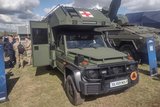
Australia orders more Bushmasters as new variants come into view
The new order will support continued production at the factory in Bendigo in Australia and further development of new types. (Photo: Thales)
The new Bushmasters will be used by the Australian Army’s second long-range fires regiment, to be based at the Edinburgh Defence Precinct in South Australia as part of the 10th Fires Brigade.


Australia has ordered another 44 Thales Bushmaster protected mobility vehicles (PMVs), destined for use with a long-range fires regiment.
The A$100 million (US$62 million) contract also supports the further development of the platform as it enters version 5.5, which encompasses substantial design changes.
More than 1,300 Bushmasters have been built with the vehicle being exported to eight nations including the UK, New Zealand, the Netherlands and Japan. It has also seen service in Ukraine against Russian forces and is being offered for major programmes such as the British Army’s Land Mobility Programme (LMP).
Thales said: “This contract will enable Thales Australia to undertake not only future upgrades of existing Bushmaster variants, but also to develop new roles and capabilities.”
The Medium Protected Vehicle (MPV) of the UK’s LMP is likely to be the last of three procurements launched after the Light Utility and the Light Protected, and it is this larger platform for which the Bushmaster is being put forward.
Thales is pushing the Bushmaster 5.5 as capable of meeting the rapid delivery requirements, with the first two or three hundred vehicles supplied from Australia. It will also look to set up local production with an eye on building an export capability in the UK.
Related Equipment in Defence Insight

More from Land Warfare
-
![British Army's open plan draws diverse offerings for Land Rover replacement]()
British Army's open plan draws diverse offerings for Land Rover replacement
The UK Ministry of Defence has avoided being prescriptive in its search to replace the British Army’s Land Rover, meaning vehicle types being offered range from Land Rover Defender Wolf II and Humvee to the hybrid series Fering Pioneer. What does this mean for the procurement process?
-
![DVD 2026: British Army’s Ajax back in the hands of users as part of a gradual return]()
DVD 2026: British Army’s Ajax back in the hands of users as part of a gradual return
The introduction of Ajax vehicles into British Army service was stopped after operator health issues were reported during an exercise, but manufacturer General Dynamics Land Systems UK believes work over the past 10 months has dealt with the problems.
-
![Europe commits to long-range fires but countries move in different directions]()
Europe commits to long-range fires but countries move in different directions
Sweden, Croatia and France are pursuing different rocket artillery solutions as European armies seek greater reach, survivability and industrial resilience.