Army-2021: VPK hopes new vehicles could fill Russian Ground Forces capability gaps
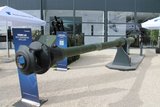
The Strela-VPK-KBM is a multipurpose vehicle intended to transport up to five passengers and cargo. (Photo: via author)
Soft-skinned Strela-VPK-KBM may replace UAZ-469 light utility vehicle, while amphibious 4x4 recon platform could be successor to BRDM.


Russian vehicle manufacturer Military-Industrial Company (VPK) has unveiled two new designs at the Army-2021 exhibition – the unarmoured Strela-VPK-KBM and a multipurpose armoured amphibious vehicle.
The Strela-VPK-KBM is a multipurpose vehicle intended to transport up to five passengers and cargo. According VPK CEO Alexander Krasovitsky, the company developed the vehicle in cooperation with Bauman Moscow State Technical University (BMSTU).
Analysts see it as a future replacement for the venerable UAZ-469 light utility vehicle, although the variant revealed at Army-2021 is still in development. Strela-VPK-KBM is part of an experimental programme initiated by the Russian MoD, which includes four variants: light armoured, armoured amphibious,
Our news & analysis is now part of Defence Insight®
A Basic-level or higher Defence Insight subscription is now required to view this content.




More from Land Warfare
-
![Rheinmetall advances longer 155mm ordnance with 30% range increase]()
Rheinmetall advances longer 155mm ordnance with 30% range increase
Rheinmetall has begun initial firing trials of a new 155mm/60-calibre artillery ordnance that could deliver up to 30% greater range than its existing 155mm/52-calibre system, as production of the current gun expands across Germany and the UK.
-
![Trans-European iMUGS2 uncrewed systems programme set for three-day exercise in 2028]()
Trans-European iMUGS2 uncrewed systems programme set for three-day exercise in 2028
The next stage of the Integrated Modular Unmanned Ground System (iMUGS) programme, dubbed iMUGS2, was launched in November 2025. Three major demonstrations are planned before the end of 2028.
-
![How joint ventures are expanding Rheinmetall's munitions portfolio (video)]()
How joint ventures are expanding Rheinmetall's munitions portfolio (video)
Roman Köhne, CEO of Rheinmetall's Weapon and Ammunition Division, discusses the company's announcements at Eurosatory 2026, including developments in defence technology, precision systems, industrial partnerships and future capability programmes.