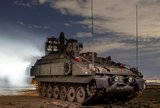
German Army trains with Spike


The German Army has wrapped its annual firing training of the Rafael Spike LR anti-tank guided missile as of 3 June.
Carried out in Germany in poor weather conditions, the training involved the firing of 54 live Spike missiles by gunners using the new Spike integrated control launch unit (ICLU) launcher.
Training consisted of complex firing scenarios such as beyond-line-of-sight engagements, retargeting mid-flight, firing in total darkness in infrared; as well as having to cope with adverse weather conditions, such as intense rain and strong winds. All 54 missiles hit their targets successfully.
Known as MELLS in Germany, the Spike family of missiles can counter land, air and naval threats at varying ranges. The missiles feature an electro-optic multispectral seeker for day/night operation and a tandem anti-tank warhead. With the missiles operating on a lofted trajectory, the warhead can strike a target at a vulnerable location with a fair degree of accuracy. In addition, Spike missiles can be mounted on a variety of platforms.
Rafael has sold over 30,000 Spike missiles to 31 countries around the world, with European production being handled by Eurospike via major EU defence Original Equipment Manufacturers (OEMs) and Small to Medium Enterprises (SMEs).
Moshe Elazar, executive vice president and head of Rafael’s land and naval division, said: ‘Spike has proved to be a high quality and reliable system chosen by 18 EU/NATO members (as well as 13 additional nations).
‘Eurospike and Rafael see great importance in maintaining the commonality of the European user nations Spike launchers and missiles. The nations’ interoperability is a key factor both tactically and economically. Part of our roadmap in all Spike weapon system upgrades includes investment of substantial R&D funds to maintain this commonality.’
Related Equipment in Defence Insight




More from Land Warfare
-
![Polaris expands Arctic mobility offering as US military orders grow]()
Polaris expands Arctic mobility offering as US military orders grow
The Military 850 Voyageur 155 Crossover has secured orders from the US Army, Air Force and Marine Corps, addressing demand for agile Arctic mobility with passenger, cargo and towing capacity.
-
![More bidders move onto starting grid for British Army Land Rover replacement programme]()
More bidders move onto starting grid for British Army Land Rover replacement programme
The Light Mobility Vehicle segment of the UK’s Land Mobility Programme for the British Army may actually be about to make progress, or at least likely bidders seem to think so. Shephard spoke with several contenders who revealed their views on how the army should replace the ageing fleet.
-
![Northrop Grumman pushing ahead with smaller Integrated Battle Command System]()
Northrop Grumman pushing ahead with smaller Integrated Battle Command System
Northrop Grumman’s Integrated Battle Command System is in service with Polish forces and is being introduced to US forces, with further development underway on the original platform as well as a smaller, more mobile system.
-
![UK’s ground-based air defence effort remains in assessment phase after third industry day]()
UK’s ground-based air defence effort remains in assessment phase after third industry day
The UK’s plan to introduce a new air defence capability into the British Army will cover short and medium-range defence as well as counter-uncrewed aerial system systems. Timelines are not yet laid out but industry is making plans.