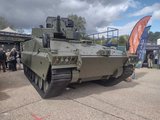
Ajax completes live firing test


The British Army has successfully completed an early live firing test programme of its Ajax armoured fighting vehicle, in Wales, the UK government announced on 12 April.
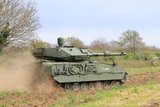
The programme involved testing the main 40mm stabilised cannon and chain gun while the vehicle was static. The early live firing was done to de-risk the formal firing programme due to take place later in 2016. The formal firing will be used to obtain further evidence before moving to manned firing in early 2017.
General Dynamics UK and Lockheed Martin UK conducted the test while the UK MoD observed.
Lt Col David Cathro, senior requirements manager, Ajax programme, said: ‘The challenges in getting to this point should not be underestimated and today is the result of a lot of hard work by General Dynamics, Lockheed Martin, CTAI, DE&S and the army. Seeing the firings today gives us confidence that the army will receive this battle winning and transformational capability on time and to budget.’
The Ajax platforms are a new proposed fleet of 589 armoured vehicles that will come in six variants being developed for the British Army. Deliveries are expected to begin in 2017.
Related Equipment in Defence Insight



More from Land Warfare
-
![Air defence offerings multiply in anticipation of emerging requirements]()
Air defence offerings multiply in anticipation of emerging requirements
Air defence and counter-drone weapons continue to be developed, tested and demonstrated in anticipation of growing demand, with most solutions designed to be platform-agnostic and readily integrated onto suitable platforms.
-
![FNSS advances Indonesian Kaplan APC programme as local production expands]()
FNSS advances Indonesian Kaplan APC programme as local production expands
FNSS and PT Pindad are progressing the Indonesian tracked armoured personnel carrier programme as local production gets under way.
-
![Tulpar firing trials expand Hitfact Mk II platform options]()
Tulpar firing trials expand Hitfact Mk II platform options
Firing trials of the Tulpar and Leonardo Hitfact Mk II combination follow an integration programme covering mechanical, electrical, electronic and software interfaces.