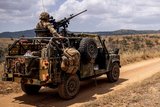
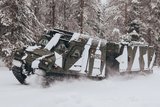
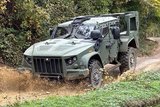
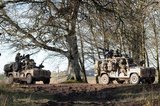
Why Middle Eastern markets demand bespoke AFV solutions
In this expert analysis, Christopher Foss looks at how armoured vehicle suppliers to the Middle East are increasingly tailoring platforms for the region’s specific operational requirements.
The Australian Defence Force has selected Bertin Technologies' Second Sight MS chemical threat standoff detector for the Australian Army, the company announced on 27 April.
The Second Sight MS is a remote gas-detection system that uses a real-time infrared sensor to detect threats such as chemical warfare agents or toxic industrial gas clouds at ranges of up to 5km.
The ruggedized system provides early warning of the threat, and gathers all the data needed to manage the attack: type of gas, location of source, extent and spread of contamination.
Romain Verollet, manager of defence and security, Bertin Technologies, said: 'The Second Sight is composed of different modules, providing it with unrivalled flexibility of use and versatility as well as compactness, deployability and operability.
'Another key advantage of our equipment is its ability to detect unexpected chemical threats in an asymmetric warfare scenario, no matter which is the type of gas used or the location of its dispersal.'
In this expert analysis, Christopher Foss looks at how armoured vehicle suppliers to the Middle East are increasingly tailoring platforms for the region’s specific operational requirements.
More than a year after selecting the KNDS Artillery Gun Module mounted on the Piranha IV 8x8 as its next artillery system, Switzerland is still awaiting the contract that will deliver the guns.
Milrem’s THeMIS uncrewed ground vehicle is one of the most battle-proven medium UGV platforms in service, with the company looking to have production versions of new large platforms ready before the end of the decade.
CENTCOM confirmed that PrSMs have been deployed in the offensive against Iran, bringing what it called “an unrivalled deep strike capability”.
Defence buyers globally are increasingly looking to tie domestic manufacturing and technology transfer into deals.
This month we saw a major presence from Turkish, Russian and Chinese companies at the World Defense Show with new vehicles from major suppliers, while elsewhere there were evolving mortar programmes and artillery modernisation efforts.