Thales’ APAR completes first Sea Acceptance Test


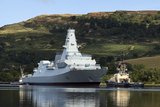
Thales’s multi-function Active Phased Array Radar (APAR) has undergone the first Sea Acceptance Test (SAT) on the new Iver Huitfeldt Class frigates of the Royal Danish Navy with positive results. The test was performed with the first APAR delivered to the Royal Danish Navy, installed on HDMS Peter Willemoes.
Thales delivered three APAR systems for the Iver Huitfeldt Class frigates under a contract signed in December 2006. Between 2011 and 2012 the systems were installed on the three ships of this class: HDMS Iver Huitfeldt, HSMS Peter Willemoes and HDMS Niels Juel.
APAR is a multi-function radar (MFR) designed to perform various tasks simultaneously, including the automatic detection and tracking of low altitude targets (such as sea skimmers), detection and tracking of air targets and missile guidance support. It is designed for the terminal guidance (CW/ICWI) requirements of SM-2 and ESSM missiles. ICWI is Interrupted Continuous Wave Illumination. This feature enables a single fire control radar to control several missiles simultaneously, thereby enhancing a ship's defence capabilities.
The APAR antenna consists of four arrays, each array composed of more than 3000 very small radar transmitter/receiver (T/R) elements. The combination of T/R modules in one array can generate narrow beams that can be pointed in any direction within a cone of about 140 degrees in azimuth and 85 degrees in elevation. Combined, the four arrays cover the full 360 degrees. Switching from one beam to another can be done very rapidly. The use of so many T/R modules gives this radar unique performance and high operational availability. The inherent agility of APAR guarantees a high performance in the most adverse conditions, under severe electronic protection measures.
Gerben Edelijn, CEO, Thales Nederland, said of the SAT: 'This SAT demonstrates our capability to maintain the highest possible level of product quality over a long period of time. We are proud of the excellent relation with the Royal Danish Navy.’
Following this SAT, there will be a Harbour Acceptance Test later this year to test the ship’s Anti Air Warfare and Fire Control capabilities. The programme is scheduled to end early 2014.




More from Naval Warfare
-
![UK ‘Hybrid Navy’ steps up as Norway cooperation reinforces Arctic strategy]()
UK ‘Hybrid Navy’ steps up as Norway cooperation reinforces Arctic strategy
As Russia commits billions to new warships and stealth submarines, the UK is reshaping its strategy with expanded troop deployments, shared frigate fleets and a shift towards uncrewed platforms.
-
![How the Hedge Strategy will impact the US Navy’s future capabilities]()
How the Hedge Strategy will impact the US Navy’s future capabilities
The US Navy Hedge Strategy is intended to provide a lethal, modular and cost-effective fleet while accepting Washington’s fiscal and industrial constraints.
-
![US Navy and Raytheon explore additional applications for Mk 58 CRAW torpedo]()
US Navy and Raytheon explore additional applications for Mk 58 CRAW torpedo
Designed as an anti-torpedo and anti-submarine capability, the USN and RTX foresee the Compact Rapid Attack Weapon’s potential for deployment from surface ships and aerial and uncrewed platforms.
-
![RTX Raytheon targets nearly 170% RAM production increase to meet global demand]()
RTX Raytheon targets nearly 170% RAM production increase to meet global demand
The US multinational company is currently assembling 300 Rolling Airframe Missile rounds per year, with plans to reach 800 units annually after significant investment and modernisation of its facilities.