Raytheon demonstrates Tomahawk re-targeting


The Tomahawk Block IV cruise missile has successfully demonstrated new capabilities in a test conducted by the US Navy and Raytheon, the company announced on 5 October.
The tests were undertaken to demonstrate that the missile's strike controllers, located at multiple fleet headquarters, can control and redirect multiple missiles simultaneously.
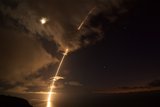
During the test, the missile took a reconnaissance photo and followed orders to re-target in mid-flight. It was launched from a guided missile destroyer USS Gridley (DDG 101). The missile used its onboard camera to capture battle damage indication imagery and transmitted the image to fleet headquarters through its two-way UHF SATCOM datalink. The missile then entered a loiter pattern to await further instructions.
The missile was retargeted with a new aim point on the navy's range at San Nicolas Island, off the coast of southern California, by the strike controllers at the US Fifth Fleet headquarters in Bahrain. The missile performed a vertical dive and struck the designated target.
To reduce testing costs, only one missile was put through a live launch demonstration; the rest were flown via computer simulation through various missions directed by forward deployed strike controllers.
Dave Adams, senior program director, Raytheon Tomahawk, said ‘We have once again proven the flexibility and utility of the Tomahawk Block IV missile, which has an unprecedented record of reliability and combat success.
‘Tomahawk continues to be the weapon of choice for combatant commanders requiring very long range, precision strike, with the flexibility to loiter and re-direct after launch. No other weapon has this capability.’

More from Naval Warfare
-
![UK’s $1 billion AUKUS support request signals strong ongoing US collaboration]()
UK’s $1 billion AUKUS support request signals strong ongoing US collaboration
The latest foreign military sales request from the UK has implications for the future of the programme and collaboration between the three nations.
-
![What the rise of interoperability between Western allies means for defence procurement]()
What the rise of interoperability between Western allies means for defence procurement
Major naval initiatives including the European Patrol Corvette programmes and Norway’s UK partnership-focused purchase of Type 26 frigates point to the growing interest in the advantages of commonality across allied navies.
-
![Kraken’s Royal Navy USV contract signals next step in crewed-uncrewed integration]()
Kraken’s Royal Navy USV contract signals next step in crewed-uncrewed integration
The UK Royal Navy’s rapid procurement of uncrewed platforms aligns with the force’s strategic shift towards a fleet better equipped to handle modern threats.