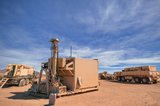
Northrop Grumman wins $577 million Army Integrated Battle Command System contract
The US Army has selected Northrop Grumman Corporation to develop the Integrated Air and Missile Defense Battle Command System (IBCS) under a $577 million, five-year, cost-plus-incentive-fee/cost-plus-fixed-fee contract for system design and development. IBCS is an integrated air- and missile-defense command and control capability. Enabled by a battlefield fire control network, the system will give warfighters the technology, tools and information they need to make better decisions on the battlefield.
IBCS will integrate current and future air and missile defense systems to allow warfighters to use any sensor and any weapon to achieve mission objectives in a true open architecture environment.
The Northrop Grumman IBCS solution is based on a non-proprietary, open architecture approach that establishes a network-centric system-of-systems solution for integrating sensors, weapons, and battle management command, control, communications and intelligence systems (C4ISR). The solution uses common software and creates standard interfaces that will allow warfighters to take advantage of expanded sensor and weapon system combinations through an integrated fire-control network.
Systems that will be integrated via IBCS include Patriot, Surface-Launched Advanced Medium Range Air-to-Air Missile (SLAMRAAM), Joint Land Attack Cruise Missile Defense Elevated Netted Sensor (JLENS), Improved Sentinel radar, and–if the US Department of Defense directs the inclusion–Terminal High Altitude Area Defense (THAAD) and Medium Extended Air Defense System (MEADS).
“IBCS takes care of the science of warfare, so the warfighter can focus on the art of warfare. The system provides unparalleled situational understanding and the knowledge needed to make risk-based decisions in a highly time-sensitive environment,” said Linda A. Mills, Northrop Grumman corporate vice president and president of its Information Systems sector. “We are honored to have been selected to help the Army get this critical capability deployed to the warfighter.”
“Northrop Grumman has been a pioneer in providing integrated battle command solutions to our customers. IBCS is another evolution of a software and hardware development process that continues to affirm Northrop Grumman’s commitment to leadership in providing net-centric solutions that are highly adaptable to the warfighter’s needs in a rapidly changing environment,” said Karen Williams, vice president for Air and Missile Defense Systems, Northrop Grumman Information Systems.
The Northrop Grumman team includes The Boeing Company; Lockheed Martin Corporation; Harris Corporation; Schafer Corporation; nLogic Inc.; Numerica; Applied Data Trends; Colsa Corp.; Space and Missile Defense Technologies (SMDT); Cohesion Force Inc.; Millenium Engineering and Integration Company; RhinoCorp Ltd.; and Tobyhanna Army Depot.
The Integrated Air and Missile Defense Project Office, Program Executive Office for Missiles and Space in Huntsville, Ala., manages the IBCS program. Northrop Grumman will also headquarter its IBCS program in Huntsville.
IBCS is expected in the field by 2014.
Source: Northrop Grumman




More from Digital Battlespace
-
![Artificial intelligence: the hope, the hype and the real-world reality]()
Artificial intelligence: the hope, the hype and the real-world reality
Artificial intelligence has supported C2 systems and decision-making for more than two decades. It has gradually built up a head of steam in the 2020s, but what is it achieving today and what role could it play in the future?
-
![SOF Week 2026: How SOF Teams Are Powering Radios, Drones and Battlefield Networks (video)]()
SOF Week 2026: How SOF Teams Are Powering Radios, Drones and Battlefield Networks (video)
At SOF Week 2026, Sean O’Neill, Senior Business Development Manager with Iris Technology, discusses the growing importance of tactical power management systems for modern military operations.
-
![SOF Week 2026: How SOF Operators Are Driving the Future of Battlefield Communications (video)]()
SOF Week 2026: How SOF Operators Are Driving the Future of Battlefield Communications (video)
At SOF Week 2026, Austin Farnham, President of Octane Wireless, discusses how direct feedback from special operations forces is helping shape the next generation of battlefield communications technology.
-
![World Defense Show 2026: Northrop Grumman to present improved C2 management system]()
World Defense Show 2026: Northrop Grumman to present improved C2 management system
The Northrop Grumman Integrated Battle Command System is in service with Poland and the US Army with another 20 countries believed to have expressed an interest.
-
![Thales looks to boost DigitalCrew system through AI and human-machine teaming trials]()
Thales looks to boost DigitalCrew system through AI and human-machine teaming trials
The Thales DigitalCrew package, first unveiled at last year’s Defence IQ International Armoured Vehicles conference, is designed to merge imaging and apply a layer of decision-making and observation algorithms to support crew and other personnel.
-
![Babcock nears first customer for Nomad AI translation tool]()
Babcock nears first customer for Nomad AI translation tool
Nomad can provide militaries with real-time intelligence, saving critical time on the battlefield.