USAF awards another Mk21A contract modification
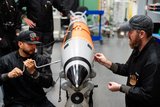
A USAF maintenance airman removes the screws holding the nose point of a Minuteman III ICBM to the rest of the re-entry system inside a payload transporter. (Photo: USAF Nuclear Weapons Center)
Lockheed Martin is to assist the much-needed US ICBM fuze modernisation programme, as the existing Mk21 fuze is already three times past its design life.


Lockheed Martin has obtained a $51.22 million contract modification from the USAF Nuclear Weapon Center to provide engineering services for arming and fuzing subsystem on the Mk21A Reentry Vehicle (RV).
Work will be performed at King of Prussia, Pennsylvania, and is expected to be completed by 31 October 2023.
The total cumulative face value of the contract is $255.31 million, the DoD noted on 4 August.
Budget documents from the USAF note that the ‘legacy Mk21 fuze is three times past its design life’ and it cannot meet requirements for the US nuclear weapons stockpile.
The USAF has requested $129.7 million for ICBM fuze modernisation in FY2022.
Lockheed Martin is already working on a technology maturation and risk reduction (TMRR) R&D contract for the RV, with a scheduled completion date of 21 October 2022.
The aim of the TMRR effort is to add the capability for the Ground Based Strategic Deterrent system to deliver the W87-1 warhead.



More from Defence Notes
-
![US speeds up B61-13 nuclear bomb production as programme moves further ahead of schedule]()
US speeds up B61-13 nuclear bomb production as programme moves further ahead of schedule
The US government plans to accelerate production even further after achieving key B61-13 milestones months ahead of schedule, as the programme advances amid growing US-China strategic competition.
-
![New UK armed forces minister frames High North defence as vital to “homeland security”]()
New UK armed forces minister frames High North defence as vital to “homeland security”
The UK’s Minister for the Armed Forces Louise Sandher-Jones made her first appearance in the role before the House of Commons Defence Committee this week to highlight efforts to improve capability in the High North.
-
![Canada seeks to strengthen industrial ties with the US on classified programmes]()
Canada seeks to strengthen industrial ties with the US on classified programmes
Ottawa explores expanding defence-industrial cooperation with Washington into sensitive programmes, an approach that could reshape NORAD modernisation, strengthen North American supply chains and create new opportunities for defence contractors.