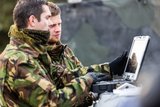
US commandos help Saudis against Yemen rebels


A team of elite US Green Beret commandos were deployed to the Saudi border of Yemen in 2017 to help find and destroy Huthi rebel missile caches, the New York Times reported on 3 May.
Since Yemen’s brutal conflict erupted three years ago, Huthi rebels have fired multiple ballistic missiles toward Riyadh and other Saudi cities.
According to the Times, which cited US officials and European diplomats, the Army special operations soldiers arrived in December to help Saudi counterparts locate launch sites and destroy the Huthis’ missile supplies.
The unannounced move shows a deepening US involvement in Yemen’s war that has seen the country spiral toward famine and claimed almost 10,000 lives.
Citing operational security, the Pentagon said it could not comment on the makeup of forward-deployed forces.
The Pentagon’s ‘limited non-combat support, such as intelligence sharing, focuses on assisting our partners in securing their borders from cross-border attacks from the Huthis,’ military spokesman Major Adrian Rankine-Galloway said.
The Times said there was no indication the commandos had crossed into Yemen.
Saudi Arabia has since March 2015 led a US-backed coalition of Arab states fighting to roll back the Huthis in Yemen and restore its neighbour’s internationally recognized government to power.
Officials told the Times the US troops are training Saudi forces to secure the border.
The Saudi troops are also working closely with US intelligence experts in the southern Saudi city of Najran, the Times said.
The Huthis, who hail from northern Yemen, control Sanaa and much of the country’s north, which borders Saudi Arabia, and the key Hodeida port on the Red Sea coast.
US lawmakers have sounded growing alarm about America’s support for the Saudis in Yemen, while President Donald Trump has bolstered ties with Riyadh and fostered a close relationship with Saudi Arabia’s Crown Prince Mohammed bin Salman.
Separately from Yemen’s civil war, the Pentagon is bombing Al-Qaeda in the Arabian Peninsula and has sent in ground troops to conduct raids against the jihadists.
The campaign against AQAP, which has taken advantage of the war to expand its presence in several areas to the south and east, has intensified under Trump.



More from Defence Notes
-
![UK urged to prioritise sea, air and space over heavy armour]()
UK urged to prioritise sea, air and space over heavy armour
A report from the Council on Geostrategy argues the UK should move away from a traditional balanced force and shift investment to naval, air and space capabilities, backed by a larger fleet of attack submarines and deeper AUKUS integration.
-
![Thales: deployment speed to determine winners in ‘production versus production’ era]()
Thales: deployment speed to determine winners in ‘production versus production’ era
At its technology summit in London, attended by Shephard, Thales UK examined the importance of speed to delivery, the growing focus on cross-domain capabilities and how procurement reform could be crucial for future battlefield advantage.
-
![Orchestrating operational readiness across every defence domain]()
Orchestrating operational readiness across every defence domain
Are all systems ready for the next mission? Have upgrades been applied? Are all assets aligned to deploy together, on time and fully prepared? In modern defence operations, readiness is no longer measured platform by platform. It is measured by how well people, assets, data and decisions move together — across land, sea and air.
-
![Global tensions drive defence supply chain scrutiny]()
Global tensions drive defence supply chain scrutiny
Governments worldwide are scrambling to decouple defence supply chains from dependency upon strategic rivals, but countries could struggle to do it all themselves.