Taiwan F-16 fighter jet crashes, killing pilot
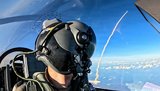
Taiwan’s air force said the pilot of an F-16 fighter jet was killed after his plane crashed on 4 June in the mountains at the start of annual live-fire drills.
The single-seat jet disappeared off the radar over mountainous terrain in the northeastern county of Keelung at 13:43 pm (0543 GMT), 34 minutes after take off, the air force said.
The defence ministry, local police and fire department had conducted land and air searches for the 31 year-old pilot, Maj Wu Yen-ting, for hours before discovering the wreckage of the plane on the evening of 4 June.
The air force said in a statement: ‘It is confirmed that the pilot has died in the line of duty ... a commission will be set up later to investigate and clarify the cause of the incident.’
Taiwan’s president Tsai Ing-wen and defence minister Yen De-fa expressed their condolences and pledged compensation to the pilot’s family.
Wu was also involved in the last F-16 accident in Taiwan, in 2013, when he parachuted to safety following a suspected mechanical failure.
The five-day ‘Han Guang’ (Han Glory) drill kicked off on 4 June with troops practising thwarting a Chinese ‘invasion’ by simulating surprise coastal assaults to reflect increased military threats from Beijing.
Although Taiwan is a self-ruling democracy, it has never formally declared independence from the mainland and Beijing still sees it as a renegade province to be brought back into the fold, by force if necessary.
Taiwan’s Defence Ministry has said the main goal of the drill is to counter any future Chinese military mission to the island.
As relations have soured between Beijing and Taiwan’s President Tsai Ing-wen, China has increasingly flexed its military muscles.
It held live-fire drills in April 2018 in the Taiwan Strait – the narrow waterway separating the Chinese mainland from Taiwan – following weeks of naval manoeuvres in the area.
In November 2017, Taiwan’s air force temporarily grounded all its Mirage jets as it searched for a pilot who went missing while conducting a training mission in one of the French-made fighters. Both pilot and plane are yet to be found.



You may also like

More from Defence Notes
-
![From systems integrator to multi-domain solutions provider (video)]()
From systems integrator to multi-domain solutions provider (video)
Philipp von Brandenstein, Head of Corporate Communications at Rheinmetall, explains how Eurosatory 2026 marked a new stage in the company's evolution.
-
![US speeds up B61-13 nuclear bomb production as programme moves further ahead of schedule]()
US speeds up B61-13 nuclear bomb production as programme moves further ahead of schedule
The US government plans to accelerate production even further after achieving key B61-13 milestones months ahead of schedule, as the programme advances amid growing US-China strategic competition.
-
![Canada’s C$2 billion ACSV deal reinforces new defence industrial strategy as allies align]()
Canada’s C$2 billion ACSV deal reinforces new defence industrial strategy as allies align
General Dynamics Land Systems-Canada is the country’s first strategic partner under the Defence Industrial Strategy’s Strategic Partnership Framework, an effort to provide companies with confidence to invest and boost the defence labour force.
-
![New UK armed forces minister frames High North defence as vital to “homeland security”]()
New UK armed forces minister frames High North defence as vital to “homeland security”
The UK’s Minister for the Armed Forces Louise Sandher-Jones made her first appearance in the role before the House of Commons Defence Committee this week to highlight efforts to improve capability in the High North.
-
![Canada seeks to strengthen industrial ties with the US on classified programmes]()
Canada seeks to strengthen industrial ties with the US on classified programmes
Ottawa explores expanding defence-industrial cooperation with Washington into sensitive programmes, an approach that could reshape NORAD modernisation, strengthen North American supply chains and create new opportunities for defence contractors.