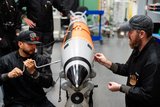
Sea Air Space 2011: Raytheon outlines growth path for ESSM


NATO countries operating the maritime Evolved SeaSparrow Missile (ESSM) have expressed an interest in an extended range variant to compete with earlier derivations of the in-service SM-2 Standard Missiles, according to Raytheon officials.
Speaking to Shephard at the Navy League Sea Air Space exposition, ESSM programme director Edward Roesly said a number of SeaSparrow operating nations had approached Raytheon with such a request. However, he warned that the US was ‘not supportive’ of this initiative at the present time as it would lead to competition with its SM-2 missile system. Today, ESSM is used by Australia, Canada, Denmark, Germany, Greece, Netherlands, Norway, Spain, Turkey and the US.
The in-service Block I ESSM is designed for ship protection against anti-ship missiles; aircraft; helicopters; and surface targets out to approximately 40km, Roesly said. The SM-2, also manufactured by Raytheon, boasts ranges between 130km (Block II) and 170km (Block IIIB), not to mention its Block IV extended range version which can engage targets up to 240km away. Raytheon was unable to comment on what would be substantial range increases for an extended ESSM variant to match SM-2 capabilities.
In addition, Roesly said Raytheon was also developing a new warhead as part of the same Block II upgrade although he could only admit that it would provide ‘flexibility for lethality’. The Block II system is expected to reach an initial operating capability in 2015. Other improvements will include guidance upgrades and ESSM’s own active radar system.
‘We are in risk reduction right now with the EMD [engineering manufacturing development] due to start in 2014 and an initial operating capability in 2018/19,’ Roesly added.
Meanwhile, moves are also afoot to equip the US Marine Corps’ last remaining Tarawa LHA-1 class amphibious assault ship with ESSM, although Roesly conceded that this would not materialise for another three to four years.
Finally, Raytheon said it was interested in pitching ESSM to countries operating SA-6 and Hawk missiles with plans afoot to demonstrate its capability in Poland next year. SA-6 launchers are already compatible to fire the ESSM missile and Roesly admitted that there were a number of requirements in eastern Europe including not only Poland but also the Czech Republic.



More from Defence Notes
-
![US speeds up B61-13 nuclear bomb production as programme moves further ahead of schedule]()
US speeds up B61-13 nuclear bomb production as programme moves further ahead of schedule
The US government plans to accelerate production even further after achieving key B61-13 milestones months ahead of schedule, as the programme advances amid growing US-China strategic competition.
-
![Canada’s C$2 billion ACSV deal reinforces new defence industrial strategy as allies align]()
Canada’s C$2 billion ACSV deal reinforces new defence industrial strategy as allies align
General Dynamics Land Systems-Canada is the country’s first strategic partner under the Defence Industrial Strategy’s Strategic Partnership Framework, an effort to provide companies with confidence to invest and boost the defence labour force.
-
![New UK armed forces minister frames High North defence as vital to “homeland security”]()
New UK armed forces minister frames High North defence as vital to “homeland security”
The UK’s Minister for the Armed Forces Louise Sandher-Jones made her first appearance in the role before the House of Commons Defence Committee this week to highlight efforts to improve capability in the High North.
-
![Canada seeks to strengthen industrial ties with the US on classified programmes]()
Canada seeks to strengthen industrial ties with the US on classified programmes
Ottawa explores expanding defence-industrial cooperation with Washington into sensitive programmes, an approach that could reshape NORAD modernisation, strengthen North American supply chains and create new opportunities for defence contractors.