


From systems integrator to multi-domain solutions provider (video)
Philipp von Brandenstein, Head of Corporate Communications at Rheinmetall, explains how Eurosatory 2026 marked a new stage in the company's evolution.


The Research Foundation for the State University of New York is joining the DARPA-run Lasers for Universal Microscale Optical Systems (LUMOS) programme under a $19.21 million research contract.
LUMOS ‘will enable efficient on-chip optical gain to highly capable integrated photonics platforms and enable complete photonics functionality on a single substrate for disruptive optical microsystems’, the DoD noted on 14 September.
Work will be performed in Albany, New York (48%); Santa Barbara, California (21%); Boston, Massachusetts (26%); and Greensboro, North Carolina (5%), with an expected completion date of September 2024.
LUMOS aims to bring high-performance lasers and amplifiers to manufacturable photonics platforms ‘through heterogeneous integration of diverse materials’, according to the DARPA website.
In particular, the programme seeks to develop integrated photonics technology along three vectors: scaling complexity, scaling power, and scaling spectrum.
For scaling across the spectrum, LUMOS aims to create photonic circuits with integrated lasers operating across the visible spectrum with a wavelength-by-design methodology to enable atomic microsystems for positioning, navigation, and timing applications, as well as compact quantum sensors and information processing systems.
As part of our promise to deliver comprehensive coverage to our Defence Insight and Premium News subscribers, our curated defence news content provides the latest industry updates, contract awards and programme milestones.


Philipp von Brandenstein, Head of Corporate Communications at Rheinmetall, explains how Eurosatory 2026 marked a new stage in the company's evolution.

The US Department of Defense has requested new contracting authorities from Congress, using the Army's MV-75 Cheyenne programme to demonstrate how competition, digital engineering and closer industry collaboration could accelerate acquisitions.
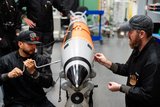
The US government plans to accelerate production even further after achieving key B61-13 milestones months ahead of schedule, as the programme advances amid growing US-China strategic competition.

General Dynamics Land Systems-Canada is the country’s first strategic partner under the Defence Industrial Strategy’s Strategic Partnership Framework, an effort to provide companies with confidence to invest and boost the defence labour force.

The UK’s Minister for the Armed Forces Louise Sandher-Jones made her first appearance in the role before the House of Commons Defence Committee this week to highlight efforts to improve capability in the High North.

Ottawa explores expanding defence-industrial cooperation with Washington into sensitive programmes, an approach that could reshape NORAD modernisation, strengthen North American supply chains and create new opportunities for defence contractors.

Connect with us on socials


