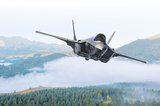
USN orders EW simulation pods
EW pod undergoing maintenance at Montgomery Regional ANGB, Alabama. (Photo: USANG/Airman 1st Class Hayden Johnson)
DLQ-9 pods and associated equipment will support work by the Naval Air Warfare Center Weapons Division on EW threat simulation.


The US Naval Air Warfare Center Weapons Division (NAWCWD) has awarded Global Technical Systems (GTS) an $81.34 million IDIQ contract for one lot of DLQ-9 pods for EW simulation, the DoD announced on 13 August.
One other bidder competed against GTS.
The contract also includes hardware for DLQ-9 pod modifications, and data required to simulate EW threats.
The pods and associated equipment will support work by the Naval Air Warfare Center Weapons Division on EW threat simulation for weapons development, test and evaluation, fleet training and target applications.
Work will be performed in Virginia Beach, Virginia, and is expected to be completed in August 2026.
DLQ-9 carriage system pods are used to carry EW countermeasures and emitter modules.
According to NAWCWD, the pods are used ‘throughout a weapons system’s life cycle, from rack units used in laboratories and hardware in the loop facilities during development, to airborne pods for use on manned aircraft for testing and fleet training’.

More from Air Warfare
-
![New US Army UH-60M Black Hawk order bridges uncertain path to MV-75 transition]()
New US Army UH-60M Black Hawk order bridges uncertain path to MV-75 transition
The US$234 million award for 16 Sikorsky UH-60Ms preserves near-term production, but funding uncertainty and an undefinitised contract leave the US Army’s long-term Black Hawk requirements unresolved.
-
![Rafale AI trials highlight shift towards operational fighter testbeds]()
Rafale AI trials highlight shift towards operational fighter testbeds
Dassault’s latest Rafale trials join Gripen E and F-16 testing as developers explore how artificial intelligence could support and control combat aircraft.
-
![V-22 Osprey safety upgrade moves towards wider fleet installation under $35.5 million deal]()
V-22 Osprey safety upgrade moves towards wider fleet installation under $35.5 million deal
Bell Boeing will supply 73 additional ODSSHI kits as NAVAIR prepares to introduce predictive drive-system monitoring across US and Japanese V-22 fleets.
-
![AFA 2026: US Air Force examines uncrewed cargo aircraft for contested logistics]()
AFA 2026: US Air Force examines uncrewed cargo aircraft for contested logistics
The US Air Force is evaluating demonstrators for uncrewed cargo missions as it considers logistics requirements across the Pacific and other contested environments.
-
![Germany air focus: Europe’s leading near-term air market targets domestic industry]()
Germany air focus: Europe’s leading near-term air market targets domestic industry
Between 2026 and 2032, almost a quarter of EU aircraft spending is expected to come from Germany. While crewed programmes seek modernisation and replacement, uncrewed opportunities look to introduce entirely new capabilities, with both highlighting sovereignty and domestic production.
-
![Europe risks losing control of CUAS production capacity as manufacturers look abroad]()
Europe risks losing control of CUAS production capacity as manufacturers look abroad
European counter-drone developers are securing early orders in the Middle East while slow domestic acquisition processes threaten to redirect production capacity, expertise and investment away from Europe.