Leonardo’s cutting-edge uncrewed technology preparing for flight
Further to learnings and technology developed through the first two phases of the RWUAS programme, Leonardo is now creating a 2-3t demonstration aircraft that will have modularity at its core.


This article is brought to you by Leonardo
The UK MoD’s (Rotary Wing Uncrewed Air Systems) RWUAS Capability Concept Demonstrator (CCD) Phase 2 contract built on the research and development activity which began under the Tactical Maritime Unmanned Air System (TMUAS) CCD programme between 2013 and 2015. Under Phase 2 further research, development, analysis and experimentation took place, which related to Vertical Take-Off and Landing (VTOL) air-vehicle technologies and platform operations, within future operating environments, fleet mixes and the overall defence aviation capability structure.
▶️ WATCH: Rotary Wing Uncrewed Air System
As part of Phase 3a of the RWUAS CCD Phase 3 Technology Demonstrator Programme (TDP), awarded in July 2022 by the UK MOD Defence Equipment and Support (DE&S) Future Capability Group (FCG), Leonardo is racing ahead with advanced research into an Uncrewed Vertical Take-Off and Landing (UVTOL) Autonomous Collaborative Platform (ACP) with the TDP anticipated to fly next year.
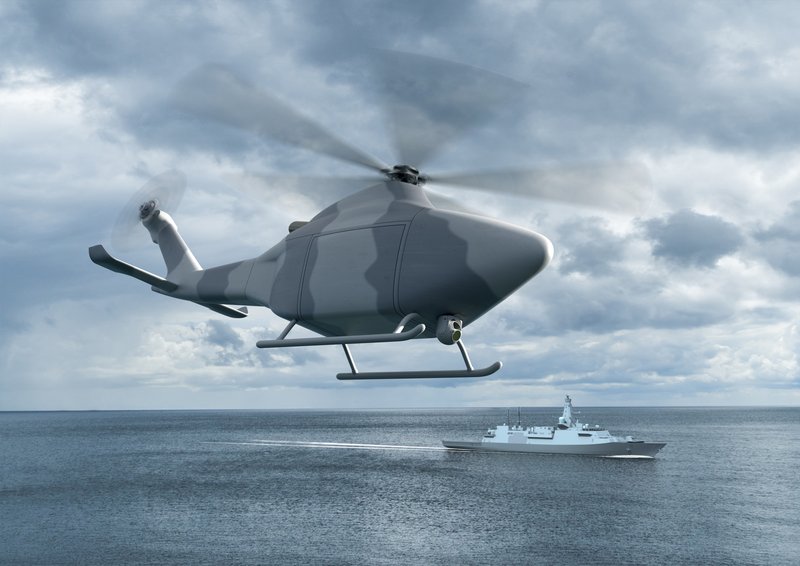
Referred to as ‘Proteus’, the TDP will inform the Royal Navy’s Future Maritime Aviation Force (FMAF) vision for Anti-Submarine Warfare (ASW) and Airborne Early Warning (AEW) support.
In close partnership with DE&S, Leonardo continues to investigate the potential systems which will contribute to the TD’s final architecture, which also form part of the UK MOD Rotary Wing Strategy, as contracted on the four-year programme. Leonardo is now adopting new technologies into the capability, including the development of a full digital twin and additive manufacturing techniques to consolidate trade-offs between capability, performance, cost, sustainability, and serviceability.
As the onshore design authority, Leonardo is exploring the art of the possible at a capability level, which will also invokes an extensive adoption of autonomy and automation into the company’s future technologies. The RWUAS TDP is unique because it is much more than the technology – it’s about the teamwork and integration that is taking place between Leonardo and the UK MOD in enabling a dynamic, transparent, and agile approach, which will ensure long-term uncrewed capability benefits that will de-risk the path to fully autonomous flight.
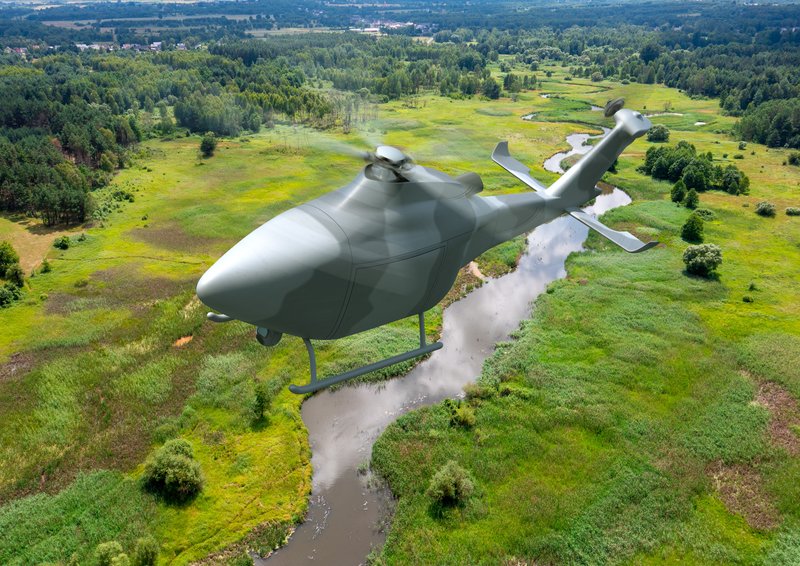
The single-engine air vehicle, in the 2-3t class, will be capable of being adapted to deliver a wide range of roles including ASW, maritime surveillance, maritime organic air missions and logistics supply. The high payload and large volume capabilities, combined with ability to operate in harsh environmental conditions, are expected to be of interest to a wide range of potential users.
Proteus represents a low-risk concept with modularity and autonomy at its core. The multi-role air vehicle will carry out on-board decision-making at a level not seen before, and delivering for future mission successes are at the heart of this development.
Uncrewed systems can operate in high-threat situations where there would otherwise be an increased Risk to Life in deploying a crewed platform. As a result of this ability to push operational boundaries and increase platform persistence, a refreshed approach to Availability, Reliability and Maintainability and modularity is a fundamental consideration for Proteus.
As a result, uncrewed systems are designed to deliver more persistent operations, there is a need to minimise maintenance, repair, and overhaul. Sustainability is a key driver in the development of the technology demonstrator, with recycled materials and attritable airframes being one of the focus points of the programme.
The project will validate that a platform with high levels of modularity and autonomy can deliver or contribute to the delivery of effect, further pioneering the future of military aviation. Digitalisation is key to delivering this agile approach, and Leonardo is working with Siemens to adapt the Teamcenter® Product Lifecycle Management (PLM) tool for the programme.
A full digital twin is being utilised to simulate design outcomes, and synthetic environments are being employed to represent the integration of airborne vehicle models. The data collected will be layered with the tactical mission system, enabling the team to determine how it will shape the future autonomous capability of the aircraft. A dynamic integration rig is also being used to test the advanced autonomous systems on board the aircraft.
The majority of the programme, which leverages Leonardo’s full range of end-to-end capabilities, from design to manufacture, will be conducted at the company’s facility in Yeovil. It will sustain and grow critical skills and generate high value design opportunities. The core team, comprising a mix of experienced rotorcraft specialists and recently recruited graduates and apprentices, has now grown to around 100 people.
All of these factors are critical in ensuring the technology demonstrator takes flight next year.
Related Programmes in Defence Insight
Related Equipment in Defence Insight


More from Industry Spotlights
-
![Shield the warfighter, win the fight (video)]()
Shield the warfighter, win the fight (video)
BAE Systems’ Intrepid Shield™ approach delivers full-spectrum electromagnetic protection to detect, exploit, and counter advanced threats.
-
![How joint ventures are expanding Rheinmetall's munitions portfolio (video)]()
How joint ventures are expanding Rheinmetall's munitions portfolio (video)
Roman Köhne, CEO of Rheinmetall's Weapon and Ammunition Division, discusses the company's announcements at Eurosatory 2026, including developments in defence technology, precision systems, industrial partnerships and future capability programmes.
-
![From systems integrator to multi-domain solutions provider (video)]()
From systems integrator to multi-domain solutions provider (video)
Philipp von Brandenstein, Head of Corporate Communications at Rheinmetall, explains how Eurosatory 2026 marked a new stage in the company's evolution.
-
![Maximise survivability with advanced electronic warfare (video)]()
Maximise survivability with advanced electronic warfare (video)
BAE Systems’ all-digital EW delivers 360-degree threat awareness in contested environments, boosts survivability, and cuts lifecycle costs.
-
![“Timelines are measured in seconds”: tackling the UAS threat with dispersed defences]()
“Timelines are measured in seconds”: tackling the UAS threat with dispersed defences
Small uncrewed aerial systems (UAS) have transformed the battlespace, posing a complex threat across all domains. Militaries now need counter-UAS (CUAS) capabilities that defeat the danger while meeting demands around readiness, manoeuvrability and adaptability, according to Mike Spina, Director, Global Sales and Business Development for Targeting and Sensor Systems (TSS) at L3Harris Technologies.