Saab to upgrade Hungarian Gripens
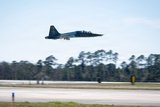
Hungary has operated Gripen C/Ds since 2006-2007 under a leasing, maintenance and training arrangement with the Swedish government. (Photo: Saab)
MS20 Block 2 upgrade will enhance sensor, communications and weapons capabilities of Hungarian Gripen aircraft.


Saab is to modernise the Hungarian Air Force fleet of 14 JAS 39C/D Gripen fighter aircraft, after negotiations were concluded between the Hungarian government and the Swedish Defence Materiel Administration (FMV).
The MS20 Block 2 upgrade in Hungary will bring ‘a number of improvements’, Saab claimed in a 12 January statement, although it did not disclose when the modernisation programme will be completed.
Sensor enhancements include a radar upgrade to increase the air-to-air target tracking range and performance of the PS-05/A Mk 4.
‘This allows better detection capability of small air-to-air targets, improved clutter suppression, and brings growth potential for further developments in the air-to air and air-to-ground modes,’ Saab noted.
MS20 Block 2 will also enhance Link 16 data link communications functionality and update secure voice communication to the latest NATO standard. The upgraded Hungarian Gripens will also be fitted with IFF Mode 5 equipment.
The upgrade will allow the Hungarian Air Force to arm its Gripens with a broader variety of weapons, such as the IRIS-T short-range air-to-air missile, the GBU-49 laser-guided bomb and the Meteor beyond visual range AAM.
Hungary has operated 14 Gripens since 2006-2007 under a leasing, maintenance and training arrangement with the Swedish government.
Related Equipment in Defence Insight




More from Air Warfare
-
![USAF opens B-52 upgrade to new companies as major programmes fall behind schedule]()
USAF opens B-52 upgrade to new companies as major programmes fall behind schedule
The US Air Force is seeking additional contractors to support communications upgrades for the B-52, while multiple Stratofortress modernisation programmes continue to experience delays, cost growth and technical challenges.
-
![July drone digest: Sovereign production takes centre stage at Farnborough]()
July drone digest: Sovereign production takes centre stage at Farnborough
Farnborough International Airshow (FIA) 2026 revealed the growing scale of the UK’s uncrewed ambitions, with companies showcasing new CCA, autonomous wingmen and surveillance drones, while sovereign production emerged as a key factor for multiple programmes.
-
![July air forces review: Farnborough steals the headlines as programmes develop]()
July air forces review: Farnborough steals the headlines as programmes develop
The biannual Farnborough International Airshow 2026 was the backdrop in July for scores of deals, partnerships and announcements, including developments in the multinational next-generation Global Combat Air Programme and the UK’s $486 million trainer aircraft requirement.
-
![Maximise survivability with advanced electronic warfare (video)]()
Maximise survivability with advanced electronic warfare (video)
BAE Systems’ all-digital EW delivers 360-degree threat awareness in contested environments, boosts survivability, and cuts lifecycle costs.
-
![US Air Force seeks avionics upgrades for ageing T-38 Talon as T-7A Red Hawk delays persist]()
US Air Force seeks avionics upgrades for ageing T-38 Talon as T-7A Red Hawk delays persist
The USAF is looking for commercial avionics solutions to improve the T-38 Talon’s reliability, readiness and flight safety as continued T-7A Red Hawk delays increase the likelihood that the legacy trainer will remain in service longer than planned.