Northrop Grumman signs South Korean laser mine detection deal
South Korea’s Mine Countermeasures programme in action with an ALMDS. (Photo Credit: Northrop Grumman)
Genohco will team up with Northrop Grumman to work on South Korea’s helicopter-based laser mine detection programme.


Northrop Grumman’s work on South Korea’s Mine Countermeasures Helicopter (KMCH) programme will be intensified by a new agreement with Genohco. Genohco, a South Korean communications and networking component manufacturer, will supply parts to help speed up the programme which is part of Northrop Grumman’s longstanding industrial cooperation with South Korea’s Defense Acquisition Program Administration.
The two companies signed a Memorandum of Understanding in August 2024, confirming that Genohco would support the manufacturing of parts for the Airborne Laser Mine Detection System (ALMDS).
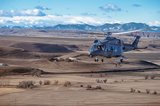
The ALMDS is a helicopter-based system which detects, classifies and localises floating and near-surface moored mines. It uses an MH-60S helicopter to provide a rapid wide-area reconnaissance and assessment of mine threats in littoral zones, confined straits, choke points and amphibious objective areas.
The ALMDS uses pulsed laser light and streak tube receivers housed in an external equipment pod to “see” the entire near-surface volume which potentially houses mines. It can be used in both day or night environments without towing equipment in the water and without having to stream out. Instead, it uses the forward motion of the aircraft to generate image data, cutting out the traditional need for complex scanning mechanisms. The ALMDS also delivers accurate geolocation data which can be used to follow up and either neutralise, recover or safely detonate the mines it detects.
So far, Northrop Grumman has delivered 24 ALMDS units to the US Navy and four to the Japan Maritime Self-Defense Force (JMSDF).
Janice Zilch, vice-president of multi-domain command and control programmes at Northrop Grumman, said collaborations like the company’s new agreement with Genohco were “key to our approach to technology development across the globe”.
Related Programmes in Defence Insight



More from Air Warfare
-
![Germany air focus: Europe’s leading near-term air market targets domestic industry]()
Germany air focus: Europe’s leading near-term air market targets domestic industry
Between 2026 and 2032, almost a quarter of EU aircraft spending is expected to come from Germany. While crewed programmes seek modernisation and replacement, uncrewed opportunities look to introduce entirely new capabilities, with both highlighting sovereignty and domestic production.
-
![Europe risks losing control of CUAS production capacity as manufacturers look abroad]()
Europe risks losing control of CUAS production capacity as manufacturers look abroad
European counter-drone developers are securing early orders in the Middle East while slow domestic acquisition processes threaten to redirect production capacity, expertise and investment away from Europe.
-
![AFA 2026: Swarm Aero eyes 2027 Gamera flight as Textron/Merlin reveal SkyCourier UX]()
AFA 2026: Swarm Aero eyes 2027 Gamera flight as Textron/Merlin reveal SkyCourier UX
Two new uncrewed aircraft concepts target very different US military requirements, from massed long-range strike to autonomous logistics. Shephard spoke with executives from Swarm Aero, Textron Aviation and Merlin Labs at this year's AFA Air, Space and Cyber conference to learn more about their capabilities.
-
![US Navy moves EA-18G Growler Block II electronic-attack upgrade into full-rate production]()
US Navy moves EA-18G Growler Block II electronic-attack upgrade into full-rate production
A US$184.25 million contract for Next Generation Electronic Attack Units advances the Growler’s modernisation as the US Navy confronts ageing systems, parts shortages and obsolescence.
-
![Could the next UAS market boom take place beyond the battlefield?]()
Could the next UAS market boom take place beyond the battlefield?
While the headlines remain dominated by the use of drones for combat operations in Ukraine and other conflicts, there are emerging use cases where the technology could usefully feed back into areas and missions outside the war zone.