NAVAIR places additional order for F-35 services
F-35s on the assembly line. (Photo: Lockheed Martin)
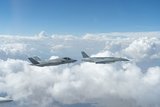
Project engineering and logistics are included in the latest F-35 support order for Lockheed Martin.


Lockheed Martin has received an $8.24 million order from Naval Air Systems Command (NAVAIR) in the US for services associated with the F-35 Lightning II aircraft programme.
The DoD noted on 5 January that the order provides programme management, delivery management, project engineering, and logistics support services ‘required to deliver air vehicle initial spares’ for F-35A, F-35B and F-35C production aircraft ordered by the USAF, USMC, USN and overseas customers (including FMS recipients).
Work will be performed in Fort Worth, Texas, and is expected to be completed in December 2022.

More from Air Warfare
-
![Loyal wingman programmes gather pace as US and European procurement plans take shape]()
Loyal wingman programmes gather pace as US and European procurement plans take shape
Northrop Grumman, Airbus and Anduril are positioning their uncrewed aerial vehicles for future collaborative combat aircraft contracts in a market that is forecast to exceed $36 billion.
-
![The new generation of defence companies emerging from the US UAV boom]()
The new generation of defence companies emerging from the US UAV boom
As the Pentagon accelerates procurement of low-cost, lethal UAVs through its Drone Dominance Program, emerging suppliers will need to demonstrate manufacturing capacity, supply chain resilience and reliability.
-
![US Coast Guard faces key procurement decisions after C-130J and MQ-9B orders]()
US Coast Guard faces key procurement decisions after C-130J and MQ-9B orders
The service is updating several parts of its aviation fleet including fixed-wing and rotary-wing aircraft and procuring uncrewed aircraft to boost its maritime surveillance.