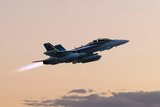
More E-2D Hawkeye aircraft arrive in Japan
Japan recently received its fifth and sixth E-2D Hawkeye AEW aircraft. (Photo: USMC)
The US is continuing deliveries of E-2D Hawkeyes and KC-46A tankers to Japan.


An additional two E-2D Advanced Hawkeye airborne early warning (AEW) aircraft for the Japan Air Self-Defense Force (JASDF) arrived by ship on 18 October, bringing to six the number of these aircraft completed for Japan to date.
The pair of Northrop Grumman aircraft (bearing numbers 475 and 476) crossed the Pacific Ocean aboard the Ocean Gladiator cargo ship. Wrapped in plastic shrink-wrap, they arrived at the port adjacent to Marine Corps Air Station Iwakuni, and were transferred to the base by road.
After their protective plastic had been removed, it could be seen that they bore USN markings. They will
Our news & analysis is now part of Defence Insight®
A Basic-level or higher Defence Insight subscription is now required to view this content.

More from Air Warfare
-
![Canada targets 2028 operational debut for AIM-9X and AIM-120D missiles]()
Canada targets 2028 operational debut for AIM-9X and AIM-120D missiles
The missile programmes form part of a broader effort to strengthen Canadian air-combat readiness as the RCAF transitions from the CF-188 to the F-35A and rebuilds its operational weapons stocks.
-
![AIM-260 JATM deal puts Australia’s missile-industrial ambitions in focus]()
AIM-260 JATM deal puts Australia’s missile-industrial ambitions in focus
While a potentially accelerated acquisition timeline could strengthen the RAAF’s long-range air combat capability, Canberra’s continued reliance on US missile production is also put under the spotlight in parallel to its push to build a sovereign industry.
-
![Attack drones versus CUAS – the future of warfare or just another trend?]()
Attack drones versus CUAS – the future of warfare or just another trend?
Demand signals for counter-drone technology are strong and the market is becoming crowded, but is this really the beginning of a new phase of warfare or will commentators be talking about something else 10 years from now?